





Bottlenecks in Business: What's Actually Holding You Back with Laurie Stirling
Apr 08, 2026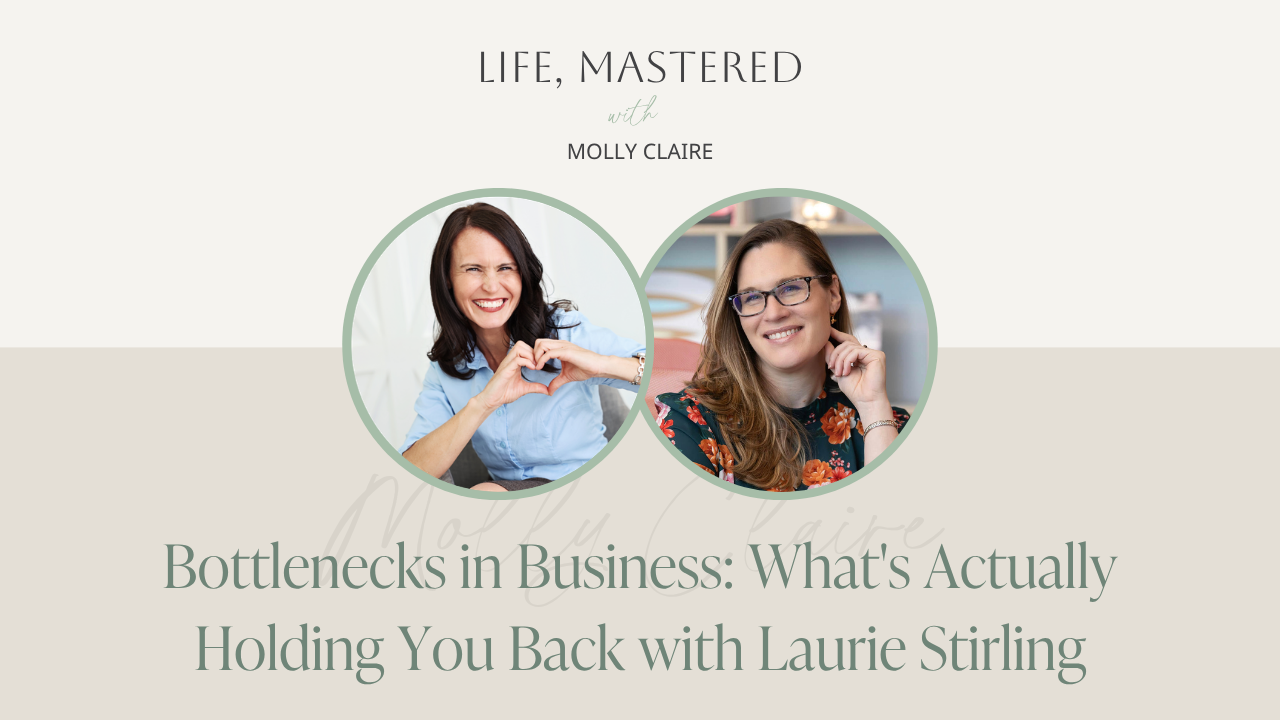
Follow the show:
Apple Podcasts | YouTube Music | Spotify | iHeart Radio | Amazon Music | RSS
When we talk about life mastery, we’re really talking about how we build a life, relationships, and experiences that allow us to feel more joyful and fulfilled. For many of us, our business is a huge piece of that. It’s how we create the life we want, and overcoming business challenges is part of the journey.
In this episode, I’m joined by Laurie Stirling, an award-winning Business Ops Strategist who helps business owners understand what’s actually happening behind the scenes of their business, including where they’re getting stuck, why, and how to move past it. Whether you’re a solopreneur, running a larger business, or simply someone who is ambitious about your life, this conversation will meet you where you are and help you better align your business with your ideal life.
Laurie walks through the five key bottlenecks in business, from brand awareness and bringing people into your world, to nurturing leads, sales and conversion, capacity, and cash flow. This conversation will help you move beyond discouraging assumptions like “this isn’t working” or “I don’t know how to do this” and toward a clearer understanding of your business so you can make informed, intentional shifts.
Bottlenecks in business don’t mean you’re failing. They mean you’re expanding to the next level. So if you’re feeling stuck or discouraged, let this be a reminder: nothing has gone wrong. You’re just being invited into your next stage of growth. Let’s get started!
What you’ll learn:
- How to identify which of the five bottlenecks is actually slowing down your business
- Why hitting an income ceiling is often a sign of a capacity or time constraint
- How to identify if what feels like a cash flow problem is actually something happening earlier in your business
- Why new bottlenecks will continue to appear as you grow and how to see them as a normal part of building a sustainable business
- How comparison can distort what you believe is possible for your business
Listen to the episode:
About Laurie Stirling
Laurie Stirling is an award winning Business Ops Strategist who helps business owners transform their business to no longer depend solely on them. With over 20 years experience as an entrepreneur, business analyst, CFO, and COO in the creative and technology industries, Laurie empowers founders to step into their CEO role and scale efficiently, delegate confidently, and take real time off without the business suffering. Her ‘Step Back to Scale’ system combines clarity through data, delegation and distilling knowledge and IP, to create businesses that are profitable, growing and self-sustaining. Laurie is passionate about helping overworked entrepreneurs regain balance, increase impact and build the life they want.
Website: lauriestirling.com
Instagram: instagram.com/laurie.stirling
LinkedIn: linkedin.com/in/lauriestirling
Free Resource: bottlenecks.scoreapp.com
Connect with Molly Claire
Get the book: She Rises: Insights and Wisdom from the Women of The Masterful Coach Collective
Molly’s Website: MollyClaire.Com
Master Coach Training 2026 Application Open
Have a question or thoughts about the podcast? Don’t hesitate to contact Molly at:
Molly’s book: The Happy Mom Mindset: mollyclaire.com/book
Free resources:
Please help Molly reach even more like-minded individuals! Simply post a review of the podcast on your favorite platform (or two). It is so appreciated.
Are you a leader, coach, or business owner who wants to inspire, influence, and cultivate lasting change in yourself or others? Unlock your full potential as a leader and coach with the 4 fundamentals of lasting change coach training program.
Apple Podcasts | YouTube Music | Spotify | iHeart Radio | Amazon Music | RSS
Full Episode Transcript:
Molly Claire 00:39
Hey, everyone. Welcome to this week's episode. I am so excited to share this conversation with you. Now, clearly this conversation is business-focused and we're going to be talking about bottlenecks in your business and really the different areas of your business that you need to pay attention to and dial in in order to succeed, to have a business that offers you more time, more freedom, more flexibility, more money. So that's what we're going to be talking about. But before we do, I want to take a step back. One of the things that you'll hear us talking about is this idea that as a business owner, I know those of you that are business owners will relate to this. When things aren't going the way we want in our business, we can tend to catastrophize a little bit. And in fact, instead of looking honestly at these different areas of our business and what needs to be tweaked, instead we say things like nothing's working. Maybe I'm not cut out for this. Nobody wants what I have to offer, et cetera, et cetera. We catastrophize, make these broad statements about who we are or who we're not or what's possible or what's not possible. It's not useful, right? And it's okay. We don't have to criticize ourselves for doing this, but notice that it's really not useful because not only does it not help you to have good energy and focus as the business owner, but you're not solving the problem. And so before we dive into this interview, I want you to take just a minute right here with me right now and ask yourself where in your life are you possibly doing this same thing in your marriage or partnership relationship? Are there broad frustrations that are stressing you out, leaving you exhausted and hopeless? Are there areas in your life as a parent or a friend where you are feeling absolute frustration about things not going well, wondering how you're going to figure out how to make it better? Is this happening for you in your financial life? Is this happening for you in your own health, your own sense of wellbeing? And if this is the case, I want you to take in these same principles that we're talking about in business rather than allowing the big emotions of the moment to overwhelm you, to shut you down and to lead you to these broad statements that aren't helpful. How can we, how can you, how can I, how can all of us take a minute to say where is the one area or that one thing within this where I can focus to make a little bit of progress, to make a little bit of change?
Molly Claire 03:32
Because I know I've experienced, I've witnessed, I've seen, I'm confident that as we can be solution-focused on one thing at a time, and as we are doing this in alignment with what matters to us, we will be able to make the shifts that we want. So there are a few thoughts for you and without any further ado, here is a fantastic conversation with Laurie Sterling. Hey everyone, welcome to this episode where we are going to be having a conversation. I've got Laurie Sterling here on the podcast. Welcome, Laurie. It's so good to have you. I'm really excited to share what Laurie has to share with all of you listening because, you know, every single week we're talking about what does it mean to really have life mastery, right? And how do we build a life, relationships, business experiences that allow us to just have the most full and joyful experience of everything. And I know I can say for me as a business owner and having my business be a big factor in how I create the life that I want, learning more about how to run a business effectively is a big deal, is important. So, as we dive into this conversation, today's conversation is definitely more business-focused. Laurie is, well, she's going to tell you a little about her in a minute, but Laurie has so much brilliance to bring to the table today as we're going to talk about where we can get stuck in our businesses and whether you are a solopreneur, you own a bigger business, or you are just a high level human being who is really going after your life with ambition. I know you're going to learn a lot from this conversation. So having said all of that, Laurie, hello, welcome, and tell my audience a little bit about you. Yeah.
Laurie Sterling 05:42
Yes, thanks for having me, I'm Laurie Sterling. I have been running a business operations coaching business for about eight years now. Before that, I ran my own web development business in Australia. I sold that business when I moved from Australia to the UK. So I'm now in the north of the UK. And I have really dived deep into operations. Before I learned that operations was even a thing, I had been running my own business for over 14 years before I even realized what operations was. And it was so part of the heart of my business without even knowing it, that I knew I needed to learn more about this subject. And so the more I learned, the more I just wanted to share it with people as well.
Molly Claire 06:27
I love that because I mean, I think that's the way, especially with many of the entrepreneurs that follow me because we're drawn to the work that we do because our hearts in it. And so I think that the reality is that many people who begin and run a business learn about some of those basics about business and the operations and all of those things later on. So I love that you're talking about this and bringing it right here to the forefront. So, and I know in our conversation before we started recording, you said something to the effect of, you know, you used to think of operations as just like a buzzword, like it didn't mean much to you. But then as you really dove into it, you started to understand how understanding more about the operations of your business could really make a big difference in terms of how profitable and how much you could sell a business for also, which is a pretty big deal.
Laurie Sterling 07:25
It is huge, yeah, there's a stat, it's here in the UK, I don't know what the relevant stat is for the USA, but 80% of businesses who go to sell in the market fail to sell because of the dependency on the owner. So if you're planning to run your business for 20 years and then hopefully sell it so that your legacy can live on to the next generation, there's four out of five chances that you're just going to have to pack up your business and close it all down and all of that just goes dormant until the next person starts from scratch and has to try and build it up again. So yeah, it's such a huge pity that it happens.
Molly Claire 08:06
Yeah. And, and I think also, you know, something I want to say, I know some of you listening may think, well, I don't really want to build the type of business that I want to sell. That's not what I'm interested in, especially people who follow me, who you just love, you know, your coaches at heart and that's what you do. And I think that one thing, you know, we won't go totally into it here because I really do want to talk about some of these bottlenecks in our businesses, but something that I really want to bring top of mind for every one of you who own a business is whether you're planning to sell your business or simply make your business more profitable and along the way, be very mindful of how you are managing the money coming in. I just like, I think it's just really important that we're as in, we work so hard for our businesses, right? We work so hard every day. And I think how important that we pause and we, we learn enough about how our business is running and how to make it more profitable and how to best use that income coming in to really make it count for us.
Laurie Sterling 09:19
100%, especially when it comes to when you're a solopreneur and you're doing everything, wearing all the hats inside your business, when you'll find that you hit an income ceiling just because you hit a time ceiling in your business. And if you're doing everything using every hour of your day available to you, you're going to hit the income ceiling that you can, but it is actually possible to reach past that income ceiling and make a whole other new level. But it's about breaking down here. Where is the current bottleneck inside your business and what's holding you back right now from taking that next level.
Molly Claire 09:57
Yeah. So, okay. So we're going to dive into these five bottlenecks, but as Laurie was talking, I just, here's what I want to say to every one of you listening, because I know I can say for me, I have plenty of moments and plenty of days that I can feel pretty down and discouraged about my business, about my finances, about relationships, right? Everything. We all have those moments. So this is what I want to say to all of you listening. If you have a business, if you're listening to this because you want to understand where you could better use your time or resources or how you could increase the amount of wealth that you are creating, I just want to remind you that what you want really is possible. You don't have to be a unicorn or, you know, some special breed of human being. Every single one of you listening here, if you want your business to be more profitable, if you want to have more wealth, if you want to create a better lifestyle, it is possible for every single one of us. I know I need to hear that a lot of the time. So I'm saying it out loud for everyone here who needs to hear it today. Yeah. Okay. So Laurie, so let's talk about these five bottlenecks in business.
Laurie Sterling 11:19
Yeah, I'd love to. So the five bottlenecks really do follow the client journey. So when somebody enters your world, they've become aware that you exist and that you solve a problem that they possibly might have, or maybe a friend of theirs has, or someone in their family has a problem that they discover you and you're like, oh, this person can solve that problem for someone I love or myself. And so that first step, just becoming aware that they know who you are and what you do is brand awareness. And that is where our personal brands come into play. That is where just being able to walk into a room and people know who you are. It could be, you know, someone knows the problem that they have, but they haven't discovered you yet. So they're searching for you. So brand awareness can happen in lots of different ways, but it's about raising our profile, making sure more people know who I am than I know of them. So you become a little bit famous in your niche or your career. You're the go-to person. And when someone has that problem and knows about it, you can be the first person that gets recommended. So brand awareness, absolutely first step and in critical.
Molly Claire 12:38
And I want to say something about this because I know this is something with my clients and my master coaches that we work on is that a lot of people have struggles with actually being comfortable with visibility. This is a big thing. And I know like I've done a lot, I have a, in my community, we have monthly calls with our tapping practitioner just around that visibility because you know, it's one thing to recognize, okay, I have to have brand awareness. I have to be out there. I have to have people know about me. But if we're terrified about that for one reason or another, the best strategy in the world isn't going to help us get there. So I just want to speak to that because you know, if this is one of the bottlenecks for people, there's usually some internal work to do as well.
Laurie Sterling 13:27
Oh, definitely. And sometimes it feels counterintuitive. Like, there was a time where I thought, well, once I'm successful, and once I've, you know, built my brand, then I will be able to speak on stages. And then, you know-
Molly Claire 13:43
I'll be confident and then I won't be comfortable being out there.
Laurie Sterling 13:48
That's right but it's actually well you need to speak on stages first so people get to know you so that you can bring people in to your world. It's actually it feels the wrong way around. Still, you actually have to do that scary stuff first and that builds your confidence because confidence comes from doing something over and over. You're just comfortable then being able to do that so yeah you have to push you push yourself outside of that comfort zone for sure.
Molly Claire 14:17
Yeah. Okay. Next up, number two.
Laurie Sterling 14:22
Number two is leads and nurture. Now these, I use both words in this particular bottleneck because yes, leads is when somebody indicates that they're interested in working with you, but or they're at least interested in the problem that you solve. They're interested in being, in understanding who you are and what you do. But the nurturing piece is they might not be ready to buy from you yet. Maybe they don't understand enough about the problem yet. They think they know what the answer is, but that there's actually an education piece that has to happen. And so there's a nurturing that happens. Yes, they're gonna indicate that they're a lead. Maybe they become a follower. Maybe they'll DM you. Maybe they'll sign up to your newsletter list. And there's lots of ways for, you know, maybe they'll actually go to your website and fill out a quote form or something from your business. So there's lots of levels of how somebody can indicate that they're interested in working with you. But there's a nurture piece that has to happen with it. You can't just bring people in your world and then ignore them and pretend that, you know, that they're just going to make that journey themselves without being nurtured. Because if you don't, somebody else will, because they're looking for that problem. The algorithm these days, if you look at one person on one topic, they'll say, oh, Meta will say, oh, you're interested in this topic? I know five other people who can also speak on this topic. So I'll keep putting that in front of you. So you want to be the one then noticing and being nurtured from and building. And that's where you build the know, like, and trust factor in your business inside that leads a nurturing bottleneck in our business. So, yes, then once you've brought them into your world, then we move into the sales and conversion. So sales isn't necessarily one-to-one sales calls or cold calling. It's about taking someone from showing them your interest to actually handing over the money. And that can happen in lots of different sales vehicles. That can happen in webinars. That can happen through newsletters. That can happen through your socials. That can happen on your website. In fact, your website is one of your biggest conversion tools. And a lot of people think building a website is lead generation of marketing. It's actually not, it's a sales and conversion tool, which you have need to bring people to your website in the first place for your website to be able to do its job to convert into a sale. So that's sales and conversion. And there's more to it than just convincing somebody to work with you and overcome objections. It's also being clear on your boundaries, being clear on what are the terms and conditions. What does the container look like? What is the journey you're gonna take them through? How do they pay their money? Is it lots of hoops that they have to jump through to be able to pay you money? Maybe they're not gonna pay you first.
Laurie Sterling 17:25
Maybe they're gonna pay you at the end because you're a product-based business and you've done all the work upfront and then you get paid right at the very end of the process. And so sometimes sales can happen one-on-one. You might be the only person in your business who can do all the sales calls because usually the business owner is the best at saying about what they do and what the value is that they produce. And so quite often, business owners end up being the bottleneck because they are the only person who can sell their business.
Molly Claire 17:55
And I, you know, I want to just pause because, you know, as you're listening to Laurie talk about these different, I've often thought of these as kind of like different phases, right? Different pieces of the puzzle with a business. And I think one of the reasons that I love taking the time with all of you listening here to break this down is that I see this all the time when I'm working with a client who is not making the money that they want to make. And this is what happens, right? How many of you relate to this? Business isn't going the way you want. And then we make this huge grand assumption that nobody wants what we have, or this business is just never going to work, right? It's like, it's like we, we have these different pieces of the puzzle, right? As Laurie, as you're talking about these different pieces that can become bottlenecks. And instead of looking at each of them in isolation as, okay, how is this piece of the puzzle going, right? We just assume that if no one's buying that we're destined to fail and nobody wants what we have when actually, right, it could be that the sales piece is off, or it could be that we don't have enough eyes, right? We don't have enough of that lead generation. So I just want to point that out because those of you listening, if you ever find yourself going to these like big statements of, oh, I'm never going to make it. I'm destined to fail. I'm not good at this, blah, blah, blah. Maybe, or maybe paying attention to each of these pieces and learning how to dial them in could make a big difference.
Laurie Sterling 19:32
Yeah, and like I so often hear that people say oh, I just need a bigger audience I need to have 10,000 followers and it's actually like if you are speaking to the right person with the right message. You don't need an audience at all. There's plenty of businesses out there that don't have a social media following that can still be yes some good lead generation. And yes that sales and that good reputation that goes with it.
Molly Claire 20:00
Yeah. Such a good reminder. Keep going. This is really good.
Laurie Sterling 20:05
Right. So when they're handed over the money, they're ready to work with you. Now we're at capacity. What is the maximum capacity inside your business? And this is really intrinsically linked with the cashflow bottleneck as well. So sometimes cashflow is collected before we deliver and sometimes it's collected after and sometimes it's collected as a deposit and then you pay the final piece at the end or broken up. So cashflow and delivery kind of come hand in hand. So if you are at max capacity and you're still having cashflow problems, then you don't have a capacity problem. You have a cashflow problem. And that means that we might need to look at your pricing. What are you pricing your services and are you pricing your scoping your projects just for the delivery aspect or are you pricing for the whole journey that your client has to go on? The cost of acquiring that new lead, the cost of sitting down and having a sales call, the cost of putting out ads in the first place so that the whole client journey needs to be taken in consideration when you're scoping the cost of either a project or a product that you might be selling as well. So are you charging enough? Maybe your overheads have blown out and you need to pull them back in. I've seen this happen with clients where their business was doing really well for a period of time. So their expenses inflated a bit during that time to support them, but then they might've gone into a lower period and they kept their expenses up thinking, Oh, just as soon as you know, X, Y, Z happens, as soon as I make that next launch, as soon as that next thing happens. And then they realize on now I didn't reach the income goals that I was wanting. Now I have to pull back my expenses. So it's trying to forecast those before you have to fire somebody or something like that. We certainly want to avoid that. So looking at cashflow is part of that. Looking at your pricing, looking at how often you do, do you need to start charging deposits upfront? Or maybe it's that clients owe you money and you're not following up or, you know, their direct debits or their bank fees or, you know, they're not paying them in time and you're having to chase people all day because of unpaid invoices and things like that. So yeah, that's the cashflow piece. So if, but if I was to ask you, if you might say, look, I have a cashflow problem. And the first question I ask is, are you at capacity? And you're like, no, I'm not at capacity. I could still bring on two or three or five more clients. Then cashflow isn't necessarily the problem.
Molly Claire 22:56
It's before that, right? It's either brand awareness or leads and nurture or sales.
Laurie Sterling 23:03
Yes, exactly. So then let's go back to delivery and capacity. So when we're working out our sales goals, let's say I work out how much I want to take home as a wage, and I work at how many expenses I have in my business, and then I'm like reverse engineering those numbers, add on a bit of tax. And I'm like, okay, my goal is, you know, 10,000 for the month to be able to pay all of my bills. And so you reverse engineer your numbers by looking at your packages and saying, okay, well, to be able to reach that, I have to sell five clients in a month. That's, you know, one per week, or, you know, one and a half per week, something like that. But that's taking into account. If you are at max capacity, what happens if you fall below max capacity, we actually want to have a bit of a buffer in that amount. You can work below capacity and still be able to achieve the income goals that you want inside your business. Then we have what happens when we're at max capacity, and we've still got sales and leads and marketing still happening. A, do we turn off the marketing funnel altogether? And we sort of just continue working inside our business because we're at max capacity? Or do we keep it trickling just a bit more so that when the next client, like when you finish working with one client, the next client is standing there ready, waiting for you to take their money. So it's a matter, it's, that's balancing the supply and demand in our business so that we, we still want a bit more demand than we can supply. Because that keeps us at over capacity. That keeps us, we'll have a wait list, but not to the extent that we're on so many clients that we have, that we can't deliver our service with excellence. What does that look like? How many clients is too many? Because if I'm feeling like I'm even like my mental, like maybe technically I've got capacity, but I'm thinking about this thing I have to do for that client and that other thing, and I have to check on my team and check my team's work that it's getting done is my mental load feeling like it's at capacity. And then so I'm not wanting to show up and do my marketing because I'm like, well, if I get any more clients, I am not going to be able to handle anything else. And then that's another reason to feel like actually my capacity is the bottleneck that's affecting the leads that are coming in. Yeah. And I'm getting heaps of leads coming in, but I'm ghosting them at the sales page because if I said, if everyone who I sent quotes out all said yes, then like I'm going to break down and burn out and not going to be able to hold it all together.
Molly Claire 25:58
This is one area that is one of my favorites to give guidance on. The other ones I'll admit, I've got a lot of learning curve on all the other bottlenecks here. But I think that because I had seen it, you know, my sister and I, we had a joint business for three years and this was the like space that I feel like it was she and I really did excel at this piece. Every time we would have a new cohort come in, we would make our list of everything we promised and we're like, and how are we delivering on it? And we would really, we really challenged ourselves to see how we could deliver the more people we got, how could we deliver a genuinely better experience? Not just lip service, not tell them they're getting a lot, but actually give them a richer experience while, while using less of our resources. And it's really cool to realize that you really can do that. I think you can really master this capacity space really well. And I think we've all experienced what it's like when people don't. It's like what I call it sloppy scaling. When people just scale with, and if all the other pieces are looking good, right? This number's looking good. This number's looking good. But if that capacity piece falls through the cracks, that's when I feel like the quality and integrity of the business is a huge disappointment to people. And so it's a big deal because it affects reputation and it's just, it's not a good way to run a business.
Laurie Sterling 27:31
Yeah, that's it. And so this is the crucial piece where if you feel like the delivery and capacity is dependent on IP that you are holding inside your head, then we need to start extracting that IP and understanding how do we keep the quality so the team can also be able to keep the same high standard as I do, but how do I ensure that without micromanaging them, without trying to keep on top of it without, yeah, burning myself out without, yeah. So what does that look like? And that is where operations comes into play.
Molly Claire 28:10
Yeah. Yeah. Okay. So these are the five. Was there more you were going to say about cashflow or did we, cause I feel like I cut you off and just to steer you a different direction.
Laurie Sterling 28:22
No, it's just the next piece is where it goes back to the top, where it goes back to brand awareness. And that's so ideally like your existing clients who have hopefully had an excellent experience with you will either come on again to work with you again for the next stage that they're at, or they're going to talk about you to everybody they know and they're gonna be your biggest cheerleader and help with your brand awareness through them just being so happy with the work that you've done. And everyone else should also have that same experience that they've had too.
Molly Claire 28:58
Yeah. Yeah, that's right. Well, this is such an awesome conversation. And in just a minute, I know you have like a free resource for everyone. So if you're interested in this, you can, Laurie will tell you more about that in a minute. But I just, I, I love this conversation. And I love that we've been here to be able to take the time to look at each piece of the puzzle. And, you know, for those of you listening and, and wondering if you have a problem with all of these areas, cause I know some people are maybe feeling that way. I think it's just so crucial to keep things in perspective when we're building a business because it can, everything can feel so big and so urgent in the moment when actually this isn't a get rich quick scheme that we're doing. What we're doing is we're building a business that will stand the test of time that has longevity. And so just be willing today to take a look at these areas for you and see, okay, where, where would be the best place for me to start taking a look at this, right? And then how can I keep things in perspective and take, you know, one step at a time. So those are kind of my thoughts, but Laurie, anything else you would add to that or anything else you want to share as we wrap up?
Laurie Sterling 30:18
Yeah, just like that last point is that's comparison, like when you think, oh, look at that person, they're doing amazingly well, they've probably done it maybe for five more years than you, or, you know, they're, they're bringing different sort of expertise to the table that they have a different area that they're excelling at, and you're not seeing that maybe because it's your weak link, your weak area, but don't forget what you actually bring to the table too.
Molly Claire 30:43
Yeah. Yeah. It's so true, right? Because we all bring something different. And also, I say this all the time, but we are usually comparing what we see on the outside of someone else with our internal experience, right? And so for me inside, personally, well, I feel a lot of big feelings, right? I feel the roller coaster and the fear and oh no, and I feel that. But my clients don't see that. Not because I'm hiding it, right? But because it's our internal experience. And so I think that's important to remember too, that be careful about just comparing the positive highlights that we see on the outside of someone else with the very real feelings inside.
Laurie Sterling 31:30
Yeah. And also keep in mind with bottlenecks, like you might realize, okay, you know, capacity is my biggest bottleneck right now. If you fix that bottleneck, you're probably going to have a bottleneck somewhere else. It'd be like, okay, well now sales, I need to, you know, double the amount of sales cause I've hired someone to help with capacity. So now that's my newest bottleneck. And it might feel like, Oh, now I've got another bottleneck. I keep failing at this business thing. It's actually a sign of growth. You have just hit a new level in your business and no matter what level you are at in your business, there will always be a bottleneck and it will be one of those five areas. And you might get to the stage where actually you're at capacity and you're really good at bringing in sales, but it's maybe a cashflow issue because you know, inflation has gotten ahead of you and you realize, Oh, now I have to look at my numbers again because you know, the economy has changed. So there will always be, um, external as well as internal reasons why there are a bottleneck inside your business. And that's okay.
Molly Claire 32:32
Yeah, I love that you brought that up and I have to just, you know, make the correlation with life because yes, our business is a growing, evolving thing, right? And you're going to solve one bottleneck and then that growth is going to open up another. And the same is really true as human beings going through life, right? We're going to overcome a challenge. We're going to finally face maybe that insecurity or fear that we have and we're going to uplevel. And then guess what? We see what it is inside of us that needs our attention next. So I think that it can be very easy to, whether in business or in life, it can be very easy to get discouraged or disheartened when you see a new challenge coming up for you, especially a new challenge coming up within you. And we can tend to believe that it means that we're moving backwards or we're not making progress or we'll never get there. But I just want to kind of, you know, share with this kind of the same sentiment that Laurie offered with business that maybe when you are seeing more work to do internally, it's actually an indication that really important growth is happening.It is. So I'm going to take that in for me today as a reminder and hopefully everyone here will. So, okay, Laurie, tell everyone where they can find you and about the resource that you have to offer. Yes, of course.
Laurie Sterling 34:11
I've given you a link to my bottlenecks quiz. So if you're wondering, yes, I probably got all of those bottlenecks, which one is the most important one that I need to concentrate on now? Yes, please do that quiz. That will give you the answers instantly. But you can also find me, I hang out mostly on LinkedIn and also on Instagram. I am on Facebook as well, but I don't tend to hang out much on Facebook. So yeah, they're the two main places you'll find.
Molly Claire 34:37
Amazing. And all of this can be found in the show notes, of course. So Laurie, thank you so much for being here. Thank you for having me.Yeah. Thank you for sharing your time and especially, you know, your insights that you've learned from your own personal experience. And what a gift to be helping, helping all of us try to forge our way in our business. Thank you. All right, everyone. I'll talk with you next week.