





Nervous System Regulation Doesn't Need to be Complicated with Dr. Kathleen Kelley
Jun 03, 2026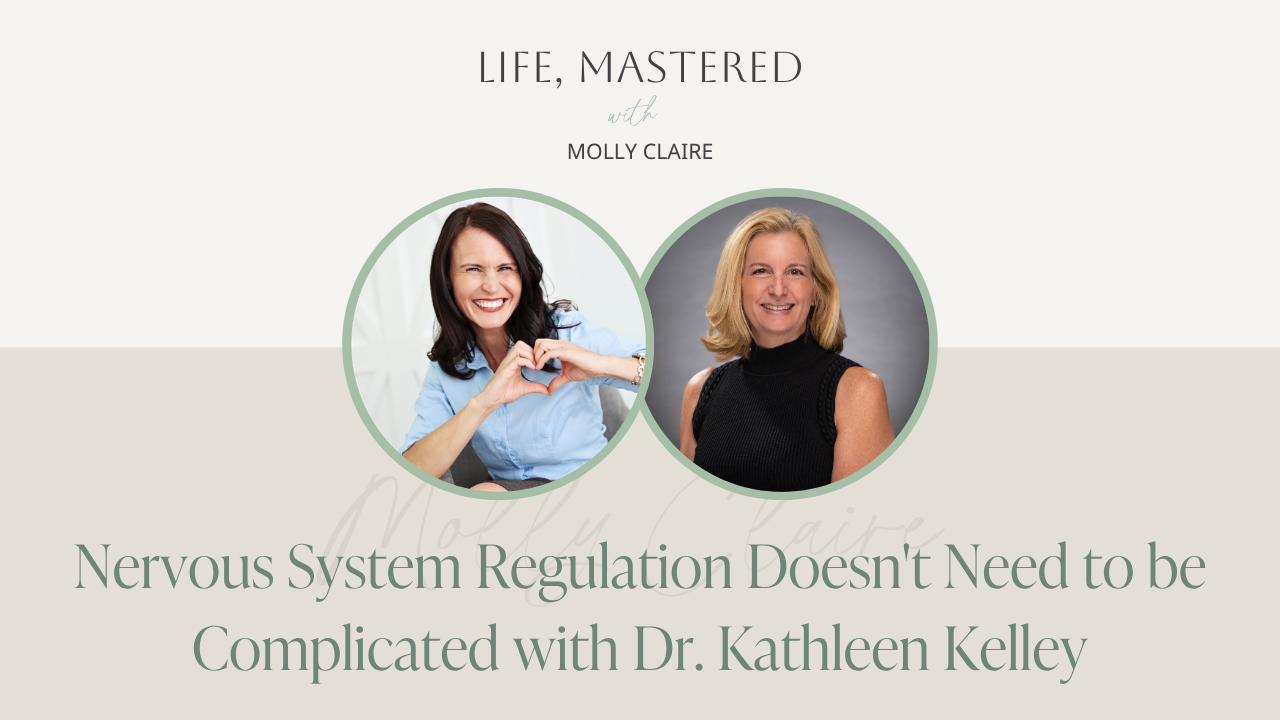
Follow the show:
Apple Podcasts | YouTube Music | Spotify | iHeart Radio | Amazon Music | RSS
When people think about stress management, it’s often through the lens of “getting rid of stress.” But stress itself isn’t the problem, and in many ways, it actually helps move us forward. The problem is staying stuck in stress all day long without giving your body moments to recover. Learning how to bring yourself back to center before overwhelm takes over is essential, and it starts with nervous system regulation practices you can easily do every day.
My guest today is Dr. Kathleen Kelley, a professor of physical therapy, board-certified neurological clinical specialist, certified yoga and meditation teacher, and life coach. She draws on her extensive experience and education in her coaching practice, helping busy clinicians and high-achieving professionals use simple regulation tools to feel more grounded, calm, and in control of their nervous systems.
In this episode, we discuss Dr. Kelley’s many practical nervous system regulation techniques, why stress release matters more than avoiding stress altogether, and the connection between regulation, emotions, and creating intentional change in your life.
This conversation is an invitation to notice how often you give yourself moments of pause, care, and reconnection throughout the day, and to consider how you may be able to give yourself more. The key to a more spacious life is practicing these small moments of regulation and self-connection one day at a time. Let’s get started!
What you’ll learn:
- Simple nervous system regulation tools and techniques that can be used on the fly
- Why nervous system regulation happens through small moments of reconnecting with yourself throughout the day
- How taking care of yourself helps you feel better while also modeling regulation for others
- The neuroscience behind why dysregulation cuts you off from clear thinking
- How manifesting works as a combination of attention, intention, and aligned action that primes the nervous system
Listen to the episode:
About Dr. Kathleen Kelley
Dr. Kelley is a professor of physical therapy at Quinnipiac University. She has taught neurologic rehabilitation, balance, falls, and vestibular dysfunction. Currently, she teaches both gross anatomy and neuroanatomy. Dr. Kelley received her BS in physical therapy from the University of Connecticut, her MS in neurology from Boston University, and her Doctorate in education from the University of Sarasota. She is also a board-certified neurological clinical specialist (emeritus), certified yoga and meditation teacher, and a certified Life Coach. Dr. Kelley’s passion for neurology, brain health, wellness, and self-care led her to dive deeply into the neuroscience of stress, stress management, and best practices for brain health. Dr. Kelley applies modern neuroscience to develop practical tools for regulating the nervous system for both educators and clinicians. When not teaching, you can find Dr. Kelley on her yoga mat, walking her beloved rescue dog Corkey, or knitting while watching reruns of Star Trek.
Website: kathleenkelleycoaching.com
Instagram: instagram.com/kathleenkelleycoaching
Facebook: facebook.com/kathleen.kelley.coaching
Free Session: calendly.com/kathleenkelleycoaching/45-minute-stress-assessment
Processing Feelings Exercise: youtube.com/watch?v=h6glPua5gOw
Connect with Molly Claire
Did you know that I’m gathering a small group of coaches to work with you privately this summer? If you’re ready to reset your business, nail your messaging, or get clear on your offer and price point to make client enrollment easier, this is perfect for you. Enrollment is by application only. Please email [email protected] with the subject “Summer Group” to request more information.
Get the book: She Rises: Insights and Wisdom from the Women of The Masterful Coach Collective
Molly’s Website: MollyClaire.Com
Master Coach Training 2026 Application Open
Have a question or thoughts about the podcast? Don’t hesitate to contact Molly at:
Molly’s book: The Happy Mom Mindset: mollyclaire.com/book
Free resources:
Please help Molly reach even more like-minded individuals! Simply post a review of the podcast on your favorite platform (or two). It is so appreciated.
Are you a leader, coach, or business owner who wants to inspire, influence, and cultivate lasting change in yourself or others? Unlock your full potential as a leader and coach with the 4 fundamentals of lasting change coach training program.
Apple Podcasts | YouTube Music | Spotify | iHeart Radio | Amazon Music | RSS
Full Episode Transcript:
Molly Claire 00:39
Welcome everyone to this week's episode. I am so excited to share with you Dr. Kathleen Kelley, who is here to talk about how we create what we want. How do we direct our intentions? How do we have that thing or achieve that goal in our life, even when we're maybe not sure how to do it, or we have those doubts? This is a little bit about what we're going to be talking about, and it's going to be a fantastic conversation. Welcome to the podcast, Kathleen. A little bit about Kathleen's credentials. Kathleen, or Dr. Kelley, is a professor of physical therapy at Quinnipiac University. She has taught neurologic rehabilitation, balance, falls, and vestibular dysfunction. She is currently teaching both gross anatomy and neuroanatomy. She received her bachelor of science in physical therapy, her master's of science in neurology, and also has a doctorate in education from the University of Sarasota. We'll just keep piling this on. What's so fun is that in a minute she's going to share with you how she's using all of this in her coaching business, but she's also a board-certified neurological clinical specialist, certified yoga and meditation teacher, and of course a life coach. You're going to learn so much from this. I already just having our little conversation before we started recording made me really, really excited about what you're all going to hear. Kathleen, tell my listeners a little bit about what you're doing now specifically in how you bring all of this education and experience into your coaching practice.
Kathleen Kelley 02:33
Well, I think there's two big categories. One is really what I learned at the Life Coach School, teaching people about how your thoughts affect your feelings and that you can have control over your thoughts and teaching people models, all the things. But I coach people who are either busy clinicians or clinicians who became managers and they're even more busy. And the thing that comes up often is there's uncertainty in the workday all the time. And there's constant input, constantly people asking you, the doctor needs to talk to you, the patient's on the phone, your other patient is ready to go, the front desk person needs you for a minute, always being bombarded. So one of the things that I've developed is just a big bag of tools of regulation techniques that can be used on the fly. Oh, I don't have time to sit on my meditation cushion. I couldn't go for my run this morning, too bad. I have something that you can do while you're washing your hands in the bathroom, let's go. My goal is to always give back to you the control of the regulation of your nervous system. People say, I'm anxious, I'm stressed out, I'm so stressed out at work. I want you to feel in control of your own nervous system. And yes, the bigger things help, going for a run, if that's your thing, I don't know why I would drive you, but if that's your thing, that's helping you 100%, that's helping you. Sleeping eight hours helps everyone. I meditate every day, that helps me. And also the little things you can do all throughout the day to draw your nervous system back to the center are important. And I can give you a whole, you know, a big bag of things that will help you stay regulated or come back to regulation because it's normal. Like having stress is normal. I think that's one of the things that people hear, oh, stress management, I have to get rid of my stress. You won't. And that's okay. You need it. It's what propels you forward. It's what makes you go for the goal. What you don't need is to be marinating in stress eight hours a day at work, every day, all day long. What we want is stress release, stress release. And that's what I help people do to take a breath, take a pause, take a moment and decide, what do I need right now before I go see this patient, before I talk to this doctor, before I call this family member back? You know, what do I need right now? To bring me back to center.
Molly Claire 05:22
Mm hmm. I love that. And everyone listening, we are going to have some specific, practical, tangible things takeaways from this conversation today. So I'm so excited about that. And, you know, I just everything you have shared and, you know, I've never been in that world of, you know, being a healthcare worker, doctor, clinician, but I know enough right from having clients and having I've had many clients who were physicians, who really expressed to me that they're really taught to ignore their own needs in just about every way to get through school, right. And then get and then when you're on call and through rounds, it's like, it is, it's not only can it be a very high stress culture, but it's well culture setting circumstances and also, it's almost like they need to be trained to take a step back and ensure that they really are meeting their needs or they're going to burn out.
Kathleen Kelley 06:33
Oh, 100%. I mean, we're told, you know, separate yourself, put it in a box, right? Your patient is in distress. Well, you have to separate yourself from that. The truth is, we're a species of connection. That's right. If I'm in proximity to someone, I'm not able to separate myself from their emotions. What I can do is recognize, Oh, this pain right now, this is not mine. I can have some empathy and go, what do I need right now? So I don't take that on. Do I need a deep breath? Do I need a pause? Do I need to say, Hey, can you sit with my patient while I go in the bathroom and wash my hands and do a round of my favorite breath work of all time is four, seven, eight, and four, four, seven, out for eight. You can do that while you're washing your hands and we're healthcare workers. We wash our hands a lot.
Molly Claire 07:33
Mm hmm. Mm hmm.
Kathleen Kelley 07:34
The whole put it in a box it just is gonna come back to bite you and everyone in health care knows that we've all experienced a sleepless night over a patient or like an inability to be present for our kids because of a situation at work it just doesn't work what it needs is attention processing and then what do I need for me and you're right you know we're either not we're either told you're doing this now or we're just not taught it's normal to feel sad about your patient and let me show you some things you can do about it like we're not taught that at all.
Molly Claire 08:14
Right, right, right. And I mean, thank goodness, it's the everything is shifting right now I just think more now than ever right and well and part of it's the algorithm, right because I'm a coach and I'm in this world. I'm like well, everyone's learning about this. I know that's not exactly true but there is so much more out there about the importance of regulating our nervous system, right, attending to our emotions, taking care of our needs. And I'm so glad because you know as you were talking, well I haven't been immersed in the world of health care, two of the populations that I've worked with very closely are moms who are putting their kids needs above their own over and over again. And I mean in there, and the truth is that we do have to make sacrifices right, like as a as a new mom, you're gonna sacrifice some sleep, right? So it's not to say that that's not going to happen ever, but the principle, the concept is the same, right? And so that's why moms can get burned out, dads can get burned out in that role, and then also just thinking about the high-achieving women that I work with and really, and this is something that I just see so often, it's like, okay as a woman as a business owner I'm the leader. I'm the one holding space for everyone, and who's the person helping me or taking care of me, right? And so anyway, I just I love this conversation and I know all of you listening here because you're here and you're listening. You probably have some flavor or version of this challenge of feeling overwhelmed and feeling all of the emotions and all the responsibilities of the people the clients the kids right anyone who you are caring for so there's a lot to be learned for sure.
Kathleen Kelley 10:11
Well, the answer to your question, who's taking care of me? You, you. You, that's right, you. And it's twofold, because when I take care of me, I'm more regulated, and my children learn that, oh, sometimes mom has to go take a bath, go out with her girlfriends, go for a walk alone without us. You know, you set an example for your children, and for me, when I need like a little extra, like right now is finals week, the stress, the whole building is vibrating right now. And when I go into their final on Tuesday, I will tell them, hey, I've been taking extra walks this week, because I'm stressed out too. So here's what I'm doing. Like I model for them things you can do that are simple, easy, and I always try for free, because, you know, students are chronically broke. So I try for free, like this you can do in five minutes for no money, for yourself, for yourself. And if you're embarrassed, for whatever reason, you can close the door to the bathroom and sit on the toilet and do it, like close the top and just sit there, because no one will know, no one will know.I do a lot of breath work in the post office.
Molly Claire 11:35
Mm-hmm. Mm-hmm. Yeah.
Kathleen Kelley 11:37
It’s stressful to me to be in the post office.
Molly Claire 11:40
Isn't it though? If I have to mail something, it is the thing I will procrastinate.
Kathleen Kelley 11:47
But that's the answer. Like, who's taking care of me? Me first. I'm taking care of me first. And then if you have someone in your life who's offering to take care of you, are you saying yes?
Molly Claire 12:01
Yeah, I was going to say because I really, I want to add to this, you're taking care of you through this lens of, you know, I think especially many, many clients and myself included, I think we can become very hyper independent women where we are really believing. And especially when I think about in the coaching world, and it's great that we want to take ownership of our feelings, right, our thoughts, like everything we want to be responsible and take ownership of where we're headed. And also, just like you said, not too long ago, right, we are, we as human beings, we are connected with one another, we need human connection and support. And so often the way I like to think about it is I'm responsible for making sure that I'm taken care of, right? But that doesn't mean that I have to do it solo, right? It means that we're asking for our needs for those in our circles, right? And do I have a friendship circle that is supportive? Do I have if I have a partner, right? Am I advocating for the support I need? So I think that it's kind of like, especially the choice to say, I will make sure my needs are taken care of only we can make that choice. And then how are we opening the door to this beautiful human connection and support that we have available? Yeah.
Kathleen Kelley 13:26
Well, and one of the things that happens when humans are together is called co-regulation. And anyone who's a mom, you know, you have the magic touch with your crying baby and your crying three-year-old and even, you know, the teenager sometimes. Why do you have the magic touch? Because you feel safe in yourself as a mom. My ability to be a mom, I got this. So when somebody hands you, your crying baby back and you immediately soothe that baby and everyone goes, well, it's not, you're seated in your own ability to be a mother, which means your heart rate is lower. Your respiratory rate is lower. Your electromagnetic field that's coming from your heart is telling the baby, oh, you're safe. It's not magic, it's neuroscience and biology. And we can co-regulate to our, you know, betterment or to our disservice. So if you think of that one friend that you come home and you're more anxious than when you went there, it's just dysregulation. You stepped into their dysregulated field. And I'm not saying you have to ditch your friend. What I'm saying is think about when you go, like when you visit, how do you wanna be before you see him or her? Because we are, we're always regulating each other. Whether you believe in any woo-woo or not, the truth of the matter is we're electricity. Like our nervous system is electricity and it radiates off of us. And one thing that I really learned to do getting older, been in my job longer is to make sure I step into my classroom regulated. But students are stressed, baseline. Students are stressed. They're feeling the pressure. There's money involved. There's grades involved. And I can either add to it or I can be sort of the sea of calm among the stress. And it's very intentional on my part. You know, if I'm having a rough time at home personally, there's extra breath work before class. There's, you know, a quick, one of my favorite practices is called peripheral vision, where I stand in front of the classroom.
Molly Claire 15:53
I'm a huge fan of this. Go ahead. I have used this many times.
Kathleen Kelley 15:57
Dan and I, it's my classroom, but maybe you're speaking, maybe you're at a meeting and you're speaking, maybe you're at a conference and you're speaking, you allow what's in the outside of your vision, what's in the periphery to take more importance than what's right in front of you. And that's a signal to your nervous system that you are parasympathetic.
Molly Claire 16:20
Mm hmm. And this is, you know, I think that for coaches, we actually we just had a masterclass on this last week in my community talking about the fact that as coaches, we are going to have our own thoughts and feelings when we are working with a client, right? And when a client brings something where maybe they are experiencing a lot of dysregulation, or they are sharing something that maybe strikes a chord with you as a coach, right? We have to remember that we are human as a coach holding that space.And how important it is that we have tools that we can use to help us to stay regulated and and to be able to stay very present with our client. And, and this is something I think is really powerful that we can use as a coach, right? I can be here on Zoom. And if I'm listening to my client, and let's say I'm noticing right feeling my emotions getting pretty big. Well, I can focus on the periphery, right? And then it just it settles everything allows me to be present. So really good trick in that regard. Yeah.
Kathleen Kelley 17:33
Yeah, it's one of my favorites because no one knows you're doing it. Yeah, you're feeling self conscious. Oh, I shouldn't be stressed out right now. I shouldn't be anxious right now. Put that thought to the side and let your peripheral vision take take it take it away. No one will know.
Molly Claire 17:49
Yeah, yeah. And it it really works so well. I remember a time when I was experiencing, I was in the midst of something and I was on the phone with my sister and I was really upset. We all know those moments.I was so upset and I was just sobbing. She made that suggestion, right? Take a minute. And it was amazing how even in a state of, some of the biggest emotions that we can feel and help me to calm down like immediately.
Kathleen Kelley 18:27
And it's not you making the emotion wrong. It's not you saying, I shouldn't have this emotion. And it's not you not being willing to process the emotion. But for the moment, you felt on the edge of a cliff. So let's just take the sympathetic nervous system down a notch. Let's let the parasympathetic system come on board and help us. And then you decide later, well, how do I want to process this? Right? Do I want to journal it out? Do I want to walk it out? Do I want to meditate it out? I'll process it. But right now I feel overwhelmed and overwhelmed feels like shorter breath, increased heart rate, maybe sweating. If you're really far in, you start to get dry mouth.
Molly Claire 19:13
It's part of it.
Kathleen Kelley 19:14
It’s part of the sympathetic nervous system, you get dry mouth. And right now is not a good time for dry mouth. I'm on a podcast. So let's bring it back. And I think it's important for people to really realize it's completely normal for your nervous system to go up and down all day long. Like she's built for that. She's built for that. What we're not built for, which is happening to a lot of us, is marinating in it all day with no release. We're not built for that. We're meant to have a stress, have something occur, process it, move on. So processing it means I'm using the cortisol that got drained into my system. I'm using it and using it up instead of collecting it, collecting it, collecting it all day until I'm just too wired to even rest.
Molly Claire 20:10
Mm hmm. Mm hmm. I think we really all have to make the choice that we will give ourselves rest and reprieve from the stress throughout the day in these little moments. Because if we just walk through life, right, the way our modern society is set up in life, it's going to be constant stressors, right?
Kathleen Kelley 20:32
Constant. And I love that you said make the choice because it is your choice yeah, your nervous system, it's your body, it's a hundred percent of choice yeah, that's something I coach on a lot like I don't have a choice. Are you sure?
Molly Claire 20:45
Yeah, we do have a choice and what I will say all day long is that by making the choice to ensure that you're okay, that your needs are met, that you are attending to your emotions and giving yourself the gift of the pause and the parasympathetic nervous system, right? Let's turn that up. By giving yourself that gift, I guarantee that you are going to be more effective, that you are going to be able to do exactly what you're wanting to do even better, right? Because the reason we say, well, I don't have a choice. It's like, well, I don't have a choice. My schedule is two-packed. I don't have a choice. People always need something, right? These are the reasons. It's like, no, no. And when you make the choice, I guarantee you're thinking more clearly which means your schedule is better managed. I guarantee you're calmer and more connected, which means the way you're showing up for people is better, right?
Kathleen Kelley 21:54
Well and that's just neuroscience. When I'm calm, I have better access to, I call it all this stuff. All the things that we've learned, right? You've done a ton of training. I've followed you since life coach school. You've done a ton of training. It's all filed away in your hippocampus, which is deep in your temporal lobe. Every time you get dysregulated, you get cut off from a lot of it.
Molly Claire 22:20
Mm-hmm.
Kathleen Kelley 22:21
When you regulate, you're back in the soup of everything you've learned. And that's when you say, oh, huh, I could move this to tomorrow. That's not a big deal. But you would never make that choice from a place of dysregulation because it will feel unsafe to move that appointment or cancel that, whatever. It'll feel unsafe.
Molly Claire 22:45
It will feel unsafe and we don't even think about it, right? It's like the idea isn't even there. It truly does feel like we don't have a choice, right? Yeah Yeah, okay. So I love all of this. I hope all of you listening or thinking about how are you doing in terms of regulating, how are you doing in terms of giving yourself what you need? How are you doing in terms of giving yourself these moments all throughout the day of reconnecting, and potentially, how could you do just a bit more of it because I know I know for sure that it is the key to feeling better and the word that's coming to me is feeling as though your life is a bit more spacious right like a little more spacious a little breathing room the ability to make choices that support a little more space and ease and connection in your life. Okay, something I would love to talk a little bit more about is, we know this the the idea of manifesting in our life right has been seen very much as a woo-woo term and it's like if you think it you create it and we often think of it as a spiritual and mystical thing. Personally, I believe there's a spiritual element to all of it and also everything that I would see and describe as spiritual. What's so fun about it is there's a scientific piece behind all of it, and so I just I love it and I want to talk about it with you.
Kathleen Kelley 24:27
Yeah, manifestation is priming of your nervous system. It's a combination of attention, intention, and then aligned action. And for you to get through the whole cycle, you prime your nervous system. So what's your intention? What's your goal? The example I like to use, because she lays it out beautifully in her book, is Mel Robbins. She talks about in her book, Let Them, how she wanted to be a speaker, a motivational speaker, which was nowhere near what she had been doing, which I really don't know what she was doing, but I'm not sure. So that's your intention, okay? Crystal clear, I want to be a motivational speaker. So now you're starting to attend to the possible opportunities for you to be able to speak. And she came across a flyer at her local library that she for some reason had never known before, that she could speak to this group of women. The flyer had probably always been at her local library, but she'd never had any reason to look at it. Now she's attending to this flyer and she has her goal and maybe she did a little meditation or a little hypnosis to get over the fear of saying, hey, Mr. Librarian, can I come speak on Wednesday to this group, right? You got to get over the fear and take the action. And the more you are clear on your goal, the more you can get your subconscious on board with it's not so scary to speak. It's not so scary to ask for what I need. It's not so scary to fill in the blank because our intentions, that's all conscious. That's your prefrontal cortex. What's holding you back often is your unconscious. Your primitive brain is afraid. Well, get in there with your emotion of, I wanna speak and it's gonna feel safe.
Molly Claire 26:35
Mm hmm.
Kathleen Kelley 26:37
Get into your unconscious, how do I do that? The two best ways, according to the literature, are meditation and hypnosis. Those are the bridges between what I'm thinking consciously and what's underneath in the unconscious. And there's a ton of literature on both. I'm more familiar with the literature on meditation, myself, and meditation changes your brainwave, so you're basically more calm when you're meditating.
Molly Claire 27:04
Yeah, I'm a huge fan of tapping. I could say so much about it.I know my listeners know that and we we teach it in Master Coach training as well and really, you know, anyway, we could we could say more about that. But a question that came up for me while you were talking or a thought that I had is you know, we talk about manifestation as if okay, we're all here. We want to manifest something. How do we do it? Really, wouldn't you say that we're all manifesting whether we're intending to or not? We're just maybe not aware of what we're directing right like I cannot be thinking at all about ooh, what do I want to do or what do I want to become I can get up, and I can go through my day, taking care of the kids and business and bills and the house and stuff and I am actually manifesting. I'm just not taking the lead in what I'm manifesting, right?
Kathleen Kelley 28:02
Right, you're manifesting out of habit. You're manifesting out of convention. You're a woman, get married, have 2.5 children, and a dog in a white picket fence. Like that got ingrained in you when you were seven years old. You are not even aware of it until maybe you decided, I don't really want any children. And that felt bad. And you went, why does that feel bad? And some people just sit and it feels bad.
Molly Claire 28:34
Mm-hmm.
Kathleen Kelley 28:35
My client, they bought their house before they got married. This was months of coaching, months of coaching to unravel society. Like why do you? When they finally moved in, to show me around on Zoom, I said, aren't you glad you're not planning your wedding too right now?
Molly Claire 28:56
Mm hmm.
Kathleen Kelley 28:57
Then, it was a huge light bulb. So yeah, we're manifesting based on habit and what's been ingrained in us, what we're supposed to do. What we think should happen and how it should go. Yeah, yeah. But all of that is unconscious, because that came from how you grew up, that came from your family. I grew up in alcoholism, so there's a huge genetic pull for me to be constantly vigilant. That's what you are in the house of an alcoholic. You are vigilant. Make sure no one upsets daddy. You're vigilant. And then all of a sudden, you have an ulcer or, I don't know, stress acne or something, and you're thinking, huh, why do I have that? Well, because you're sitting in this unconscious pattern that you can decide that you don't want it anymore. Yeah.
Molly Claire 29:51
Yeah, we have to know it's there first though, right? That's the whole thing, which is why I'm just like, I'm so crazy passionate about this work. This last week I was hosting my clients at a retreat and I say retreat, let's be honest, we're like diving into all the emotions. It's like, it's a lot of deep work, but it's so powerful. And we were talking about at one point here we all were and I'm gathered together with women who have experienced things in their life that for many people, it's like unthinkable that they would go through this and things they never would have wished upon their worst enemy and those challenges and struggles and having to work through it and heal. And it's like, we were talking about what an amazing gift that here we all are having come through the unthinkable, the unimaginable and able to genuinely thrive and be changed for the better because of it. And we were talking about how so many people don't know it's possible, right? They don't know. And there was a time that I didn't know, right? And then we go through these things and what a gift to see that we have so much more power and opportunity within our challenges and our struggles. So this was a bit of a tangent, but circling back, the truth is that we really can change our experience of our daily life. And if we think about it, right? So all of you listening here, if on a day when you're not thinking about your future, what's next or your goal, but it's just like a mundane day, or maybe you feel that's kind of the way you've lived your life. If you are actually already manifesting what is happening, right? Because you expect something to happen and it does, right? You're living your life based off of what you expect, what's the norm, and therefore your brain, your body, everything is engaging and creating it. It's pretty interesting to think about that the same is true if we're just a little more intentional, right? A little more focused on the bigger picture or what we would like or what we would hope. It's like they're both manifesting. Either way, we are actually creating our reality, but in one scenario, we actually know we're creating our reality and we get to take the reins a little bit more, right?
Kathleen Kelley 32:39
Yeah, what would it be like if you decided? My intention today is to, and it doesn't have to be, be the president of the world. It could just be, my intention today is to respond and not react when I'm engaged with these four people. Yeah, yeah. These four people who always create stress in my life. Today, my intention is to respond and not react to them. See what happens, see what happens. You never know.
Molly Claire 33:10
Yeah, right. And I just want to say, because I know for many years, the idea of responding and not reacting, the way I would interpret that is like, close up my feelings, right? White-knuckle it through. And that is not the same, right? We all know, right? We're going to blow at some point, but rather, how can we allow the feelings to be here, right? Use some of these practices and intentionally think about responding without shutting ourselves down, right?
Kathleen Kelley 33:44
Well, you're just deciding to not let the strong emotion hijack your choices.
Molly Claire 33:49
Exactly. Exactly. Beautifully said. Yeah, that's right. That's right. Oh my gosh. Okay. So I know as we're going to wrap up in the next few minutes here, but for my listeners here, and maybe they're here and they're getting excited again, reinvigorated again about the idea that manifestation is real. It is something that is happening, whether we're taking ownership of it or not. And maybe some of my listeners are thinking, you know what? Like maybe I want to step into really proclaiming this goal that I have, you know, like, what's the word I'm like tripping over my words here, really taking ownership of it, right? Claiming it, saying it out loud, or an identity shift. What would you say to them?
Kathleen Kelley 34:36
I would say get crystal clear on what it is. Like I want it to be a life coach, crystal clear. It wasn't maybe I'll go back to school and get my PhD in psychology, or maybe I'll take some courses where I work in social work. No, it was crystal clear. I wanna be a life coach. And then it's just a series of tiny, tiny actions. You know, Mel Robbins talks about in her book, how long it took her to go from free talk in the library to five or six women, some of whom she knew from town, to, you know, in front of thousands of people. It takes time. It takes time because you're priming your nervous system to get used to the new identity, whatever the choice is. And then I heard the most wonderful speech the other day was Roger Federer was talking to a graduation class. And he was talking about how much you fail. And the greats just know how to say the failure's behind me. Now I'm moving forward. It's just normal. It's normal to fail. It's normal to feel bad about that failure. And then you process feeling bad, you release it and you go, hmm, okay, how do I want to feel when I try again? And you keep going. All the breath work that I teach starts with what Patrick McEwen calls low, slow and deep, which is not the biggest breath you can ever take. It's a deep breath, slow in your belly. So we're going to do it. So it's on the recording, okay? You sit up nice and tall. If your feet can touch, that's great. If not, it's not a requirement. One hand on your belly. Other hand is just relaxed. You keep your mouth closed. You breathe in through your nose and your belly comes out towards me. Inhale and then exhale. That is low, slow and deep. Nice belly breath and release. Mm-hmm. And any breath work you go on from there starts right here. Four, seven, eight, box breathing, three-part breath from yoga, all the breaths that you've ever learned. You start right here. So if you're in fear, I want to be a life coach, but I got to get on the screen and I got to coach one of my friends in front of my teacher. Guess what I was doing in the five, 10 minutes before class started? Four, seven, eight. I was doing four, seven, eight and I was telling my nervous system, we can do this. We're safe. I'm not happy about it, okay? I'm still scared. I'm still nervous. I'm not happy. There's no rainbows and daisies.
Molly Claire 37:47
Mm-hmm.
Kathleen Kelley 37:48
But I can be calm and I'm happy about it now. Years later, after practice, I'm happy coaching, but I wasn't at first. I was scared to death. Little breath. And if you don't like breath work, there's other ways. There's other ways, many other strategies that you could learn.
Molly Claire 38:07
Yeah, well, I mean walking is so good, right just what I especially I'm a person. Movement is so good for me. And sometimes sometimes I can get caught up in the breathing and needing it to be a certain way right where it's like, okay It's got to be really good and it's got to be this and like my guidance to all of you as you're listening, just let it be easy. Let it be easy. There are a whole bunch of ways that you can process your feelings that you can regulate that you can bring your temperature down and let it be easy. Try a few things and see what works for you, but do it right.
Kathleen Kelley 38:48
Try and not every tool works for everybody. Not every tool in your bag is gonna work for every situation, don't make that mean any-
Molly Claire 38:57
Yeah, I've definitely gotten a lot better at accepting this is what works for me, this is what I like, and I just I do it full force what works for me, so.
Kathleen Kelley 39:06
Yeah, and nothing works for me if I'm eating like crap.
Molly Claire 39:09
Yeah, yeah. Oh my gosh. That could be a whole other podcast episode, right? I'm such a fan of Dr. Mark Hyman. I swear, I asked one of my, I think I asked my colleague, I was like, oh, are you familiar with Dr. Hyman? She's like, yes. And I know you like him because you always share his things on Instagram. Yes, I do. So yeah, it's good stuff. If anyone's listening and you have an in for me so I can get Dr. Mark Hyman on the podcast, reach out to me. So I'm just, I'm so excited about all the work happening now. We're understanding more about what our bodies need, what our brain needs, what our nervous system needs, just how everything fits together. And it's, it's really exciting to be a part of it. Yeah. So thank you so much for being here. As we wrap up, is there anything that you want to share with my audience? Let them know where they can find you. And of course we'll have all of this in our show notes also.
Kathleen Kelley 40:04
Yeah, they can find me my website, Kathleen Kelley coaching. And then all my socials are Kathleen Kelley coaching. So Instagram, I'm not, I'm on Facebook, but you probably won't find me. It's there, but I don't use it. I'm on LinkedIn. Yeah. And then we were talking about processing your feelings. I have a free YouTube video on how to process a feeling. So search me on YouTube. And it's, it's just there. It's free. And because the first time a coach told me that, well, how are you processing your feeling? I was like, what? What are you talking about?
Molly Claire 40:44
Can you give us the link to that YouTube video? We can put it in the show notes. Oh, sure. Yeah. Perfect. Perfect. Thank you so much for your time. I so appreciate it. Those of you listening as we're wrapping this up, I really want to encourage you to just take one or two things you heard today and just give them a try. Just one or two things. It's when we're making just every single day making a small choice to improve or implement a meaningful change, it adds up. So it's worth the time. Do it. All right. Thanks everyone. And I'll talk with you next week. Thanks, Kathleen. Thank you, Molly.