





Progress Not Perfection: Lessons from a Sobriety Journey with Jensen Rapp
Jul 01, 2026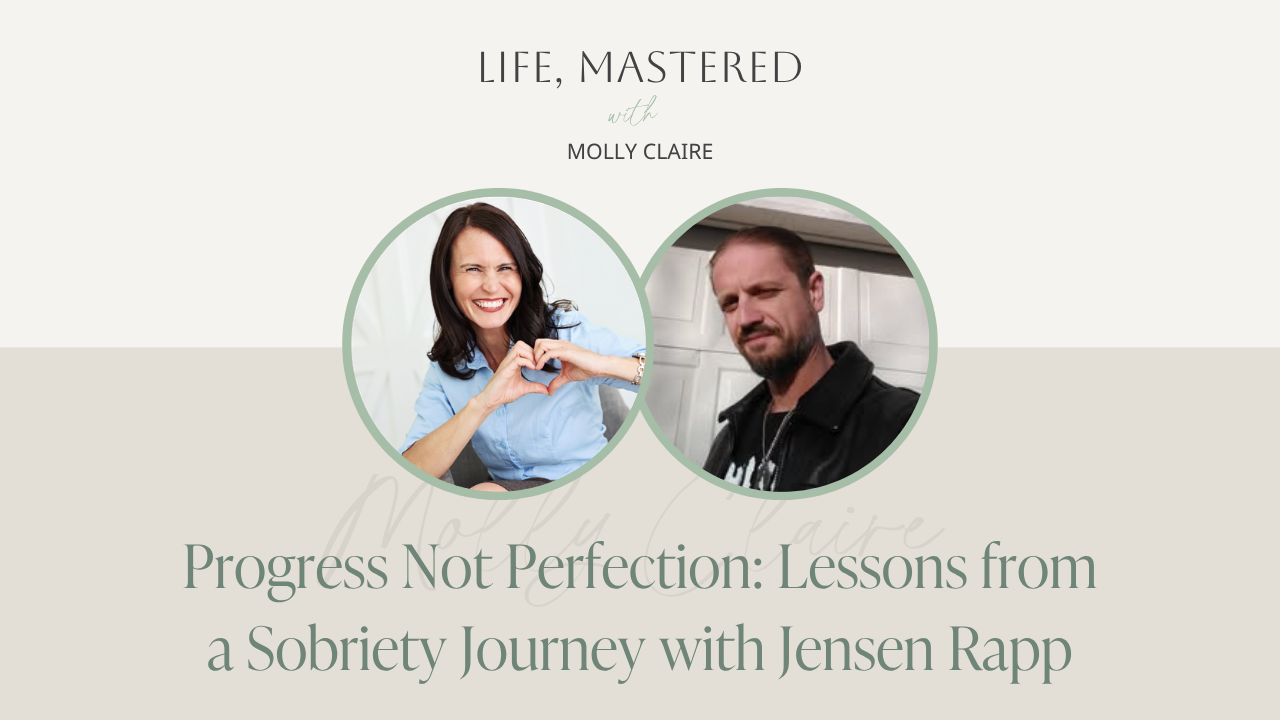
Follow the show:
Apple Podcasts | YouTube Music | Spotify | iHeart Radio | Amazon Music | RSS
One day at a time, one practice at a time, one decision at a time. That’s how you create the life you want. There’s no shortcut, whether you’re changing your relationship to your work, communicating better in your relationships, or on a sobriety journey. This episode is a reminder that you can do it.
Today, I'm excited to have a guest from my past. I recently reconnected with Jensen Rapp, whom I hadn't seen in years, because he published a workbook to help people begin and stay on a sobriety journey. He's here to share his story and the practices that have helped him maintain 15 years of sobriety after 16 years of drinking every day.
What we talk about in this episode doesn’t just apply to alcoholism. If you’ve experienced any type of addiction, or you’ve become aware of certain habits that are keeping you from living your healthiest, most fulfilling life, this is for you. No matter what your struggle is, making a change comes down to so many of the same principles you’ll hear Jensen talk about. We explore how you can make decisions that are in your best interests, truly be with yourself in the good, the bad, and the ugly, and support yourself in your growth through it all.
There is hope and possibility in any situation you’re facing right now. No matter how long you’ve done something, no matter how deep you are, there is always the opportunity for change and support to help you get there. Let’s dive in.
What you’ll learn:
- How to find your “X-factor” and think about what your life would look like without it
- How to handle your emotions when they come back after being numb for so long
- Several daily practices to help you process your emotions and be more present in your life
- The “think twice” philosophy that Jensen practices every day to live with more intention
- Why it’s important that you don’t make the decision to change until you feel ready
Listen to the episode:
About Jensen Rapp
Jensen Rapp is an artist and author. He is originally from Utah and currently lives in New Orleans. He has an AA degree in art, and is a Certified Graphic Designer. He plays drums and produced a short film with his father. He has 15 years of sobriety and is 47 years old.
Sobriety Tools: etsy.com/shop/SobrietyTools
Instagram: instagram.com/jrapp_4
Facebook: facebook.com/jensen.rapp
Connect with Molly Claire
Are you ready to create a signature program, clarify your niche and messaging, and develop a compelling offer you can confidently sell? I'm currently enrolling private clients for one-to-one coaching and would love to support you. Email [email protected] to request an application.
Get the book: She Rises: Insights and Wisdom from the Women of The Masterful Coach Collective
Molly’s Website: MollyClaire.Com
Master Coach Training 2026 Application Open
Have a question or thoughts about the podcast? Don’t hesitate to contact Molly at:
Molly’s book: The Happy Mom Mindset: mollyclaire.com/book
Free resources:
Please help Molly reach even more like-minded individuals! Simply post a review of the podcast on your favorite platform (or two). It is so appreciated.
Are you a leader, coach, or business owner who wants to inspire, influence, and cultivate lasting change in yourself or others? Unlock your full potential as a leader and coach with the 4 fundamentals of lasting change coach training program.
Apple Podcasts | YouTube Music | Spotify | iHeart Radio | Amazon Music | RSS
Full Episode Transcript:
Molly Claire 00:39
Welcome to this week's podcast. I have got another fantastic guest that I'm bringing to you today. I'm going to take a minute here and read the introduction of the workbook that you'll hear us referencing on the podcast. On the 4th of July, 2011, I woke up staring at the same neon lights of a county detox center I had seen too many times before. By then, I had spent 16 years going deeper and deeper into alcoholism. What started as sneaking liquor from my parents as a kid turned into a life built around drinking. If I was awake, I was drinking, and when I drank, my decisions opened the door to anything that would take me further out of myself. It was never enough. This is the introduction of the workbook, Staying Sober and Staying Steady, by Jensen Rapp. What's really cool about this for me is that Jensen and I were friends in middle school. The last time we saw each other in person, we were probably 13. When he came out with this and steady living, when I got my hands on this workbook and I was just so impacted, and I'm going to tell you why, I just knew that I had to reach out to him. I want to help him share his message. I wanted to bring him on the podcast to talk with all of you just about the power of being present with our emotions. The fact is that we all struggle, whether it's alcoholism, whether it is being a workaholic, whether it is constantly self-sabotaging and doing things to try to get away from ourselves and try to avoid what we're feeling, we all have these struggles. The truth is that while we all have different flavors of them at its core, the underlying issues, and I'm going to say even more than that, the solutions to this are exactly the same. That's what we're going to be talking about on today's episode. I hope you love it. I hope you are inspired. I'm just so excited to celebrate coming up on 15 years of sobriety for Jensen. Let's go ahead and get started. Welcome to the podcast, Jensen.
Jensen Rapp 03:07
Thank you so much, Molly. Yeah. It's strange how things work out. Here we are 30-plus years later.
Molly Claire 03:18
Well, and the reason, of course, that I reached out to you and wanted you here is that when I saw your workbook, of course, I was curious, I was interested, I wanted to support you. And then as I started reading it, I just was touched and inspired by the authenticity of everything you shared. What really hit me is that we all struggle and the more we can share our struggles and be honest about it and be there for one another, there's a lot of power in supporting each other. So anyway, I was just really struck by that.And that's why I wanted you to be here because I think what your message that you have to share and the tools you have are phenomenal. They are phenomenal. And I've read a lot of self-help books.
Jensen Rapp 04:11
I believe it, me too.
Molly Claire 04:14
Yeah, yeah. So one thing I want to ask right off the bat. So this is pretty exciting timing-wise, because you're coming up on 15 years of being sober on July 4. A pretty big deal. I would love to know, what is this like for you coming up on this next anniversary? How are you feeling about it?
Jensen Rapp 04:37
I am feeling it's it's kind of overwhelming a little bit sometimes to just think like that you come this far when you start out you know the agreement I made with myself is all right we're going to go for a year if things get better maybe we'll stick with it but if they're not I'm drinking again yeah yeah you know they after a year I'll say for myself they were phenomenally much better so I just kind of kept doing it and I kept getting through the obstacles and learning and being open being willing and one day at a time you know is really.
Molly Claire 05:23
Yeah.
Jensen Rapp 05:23
Some great days where you're on the pink cloud, but life still happens when you're sober, you know.
Molly Claire 05:28
Yeah, yeah. And that's one of the things we're going to talk about. I know I want to really talk about like, what do you do on a daily basis for the good days and the not so good days, right? So we're going to talk more about that as well. But one thing that I also want to talk about and have you share about is here we are talking about your sobriety and your workbook, right, in this anniversary around the corner. But all of this comes from some pretty hard and dark times. And I know something you said to me the other day when we were talking before this conversation is that you spent 16 years of your life drunk.
Jensen Rapp 06:06
Yeah. Yeah. So when you talk about like the anniversary coming up, one of the cool things about having some years is you really have a contrast to look at, you know, for me, my life is kind of in thirds right now, as far as how many years I've acquired. So it was like childhood, and that little journey, and then kind of when we met little adolescent years, and then, you know, like it was right after junior high, where we were together that, you know, I kind of got into the alcohol and got into the party scene and got into the marijuana and got into that, whatever was around, you know, and for then, at the beginning, it was kind of an innocent kind of rebellion thing.But for someone like me, the progression took over to where the last four years of my drinking career, if I wa s awake, I was drinking. And unless my body physically could not keep it down. I was drinking. And, you know, I did have good times, I'm not going to say like, it was all terrible and doom, but it created very tough mental obstacles for me, it created terrible habits and self-esteem issues, it created terrible health issues. And by the last four years, you know, it was such a dark place, that when I came out of it, and have this next, you know, 15 years, almost as long as I was drinking, there's just such a, like, variety of ways to look at life, you know, I know what it was like to be there, I can look at how it felt. And now being here, it's like, man, I've got a whole new life, like, I started from, I started from jails, institutions, you know, homelessness, all those things that I brought on myself through my habits, and through the consequences of that lifestyle. And it's all behind me. And you know, I started from nothing. And I'm just so happy. I've built so many things that I can look back on and feel good about. And you know, so it's like,
Molly Claire 08:17
One day at a time, one practice at a time, one decision at a time. Really, right? There's no shortcut.
Jensen Rapp 08:23
Yeah. Yeah. And, uh, it's just being able to do that, like, makes me, gives me a confidence that like, that I can do it no matter what, and anybody else can too. I believe anybody's got a chance as long as you're breathing.
Molly Claire 08:38
Yeah, yeah. And I want to pause for just a minute because I know, you know, for everyone here listening, you may not relate to this exact experience, right? But what I think is definitely relevant to everyone is that what's underneath is really the same for all of us, right? Whatever our vice is or whatever our, I know the other day you referred to it as like, what's your X factor, right? And for you, alcohol is your X factor. And, and I'd love to hear you share what you kind of said about like when you know the X factor, right?
Jensen Rapp 09:14
Exactly. Yeah. And, you know, and that takes some real honest, you got to look at yourself honestly, you know, it's different for everybody. You know the majority of my friends now are not drinkers, you know, they can have a glass of wine, take it or leave it and just kind of move on with life. It's not the X factor in their life.It's creating the chaos and misery. And like, like to me, it all comes down to fear. And that's what drinking was. It was a way to get rid of all my emotions, including fear and emotions, you know, especially with the way a world is now, you know, they come up so quickly, you can be triggered by so many different things. And so if your X factors, whatever it is, it could be sleeping too much. It could be, you know, lying to yourself. It could be avoidance, conversations, you know, eating TV, internet, all the things. And, but what's the one that's really like, I, I know I need to quit. I just don't know how, you know, like you, you know what your X factor is before you know what your X factor is. And it's addiction. It's the same thing. It's a, it's covering up some emotion you don't want to deal with.
Molly Claire 10:32
Yeah. Yeah. And I think that, you know, one thing that I've thought a little bit about is, is even like, what is that one thing that is really keeping you from the life that you want, from the peace that you want, from the relationships that you want? And it can be a lot of things, right? Like all kinds of addictions, right? We can even, we can be overworking. We can hyperfocus on one thing, right? To, to not have to deal with the rest of it. And so, I don't think it really matters what it is, but what matters is, are we willing to be honest with ourselves about it and actually see it? Yeah.
Jensen Rapp 11:15
Definitely. And you know, like you said, it's like working from the outside, it's outside looking in, oh, it's a great thing. And you're producing, you're doing all things, and you're gonna make it to the top, you know, whatever it is. But, you know, I have friends who are workaholics, I go on vacation with them, they can't put down the phone because they're still working, and they're just not present. And, you know, yes, their work is doing well, their businesses are doing well. But the rest of their life kind of falling apart.
Molly Claire 11:48
Yeah, yeah. And we can only run so long from what's inside of us.
Jensen Rapp 11:51
Yeah, exactly. You know, and, uh, you know, balance is a good thing. And, you know, some of those things, it is the X factor. What is the one thing that if I remove this, my life would get better, you know, give it a shot, you know, it's like, one of the things I learned about is like, if you don't think you're an alcoholic or put in whatever word, workaholic, try to go to the bar and do some controlled drinking. Say I'm only going to have two drinks. I'm going to walk away and not drink for the rest of the night. Like if you can do that, you might not be an alcoholic, but you know, it's like you're saying like workaholic, if your family needs you, if you know your health is suffering because you're not sleeping or whatever it is, it's like, you can still work, but can you do controlled work? Can you control it a little bit?
Molly Claire 12:44
Can you be present when you're not working, right? And it's, again, going back to this idea for all of you listening, when you just think like, what is my X factor? What is the thing that is getting in the way? Can you be honest with yourself about it? And this is the hard part, right? What is it gonna require of me to change this, right? To change this. And something I wanna go back a little bit because I know you were talking about the last four years of your drinking career.
Jensen Rapp 13:16
Yes, the career.
Molly Claire 13:18
And I mean, you were in a pretty low place. And I know that you've expressed like that your family like everyone had kind of given up on you like it was just kind of everyone had kind of accepted that maybe you'd be found in a ditch one day.
Jensen Rapp 13:34
Yeah, or a prison cell, you know? So, uh, it was dark and it, the thing about it is there was a comfortable like feeling in that darkness. And that was almost what I was addicted to. It was the numbness more like the alcohol created a numbness where I didn't need to feel because that's the scariest thing for so many people is fear and anxiety and all of these things. So I removed that and let me tell you the first couple of months, these emotions came flooding back in, Oh Lord. So even like happiness was uncomfortable because it was real happiness. It was things I hadn't felt for so many. I'm like, what's going on? Oh my God. I think I'm happy. And yeah, took some getting used to, but you know, those are the things that we all deal with in different ways. And, you know, those are the tools that I kind of wrote about is like, how do you deal with those emotions in a positive way? How do you not get overwhelmed by those emotions and, you know, kind of be present for them because they deserve recognition. They're all lessons and you get stronger every time you get through it. Like, and sometimes happiness is hard to deal with just because it's unfamiliar.
Molly Claire 15:00
Absolutely. I mean, a question I have for everyone listening, and maybe you'll notice this, how often do you find yourself when you've experienced something really happy and exciting, you go eat. We overeat sometimes to bring the feeling down. And so it's like, not only do we have to learn how to be with what we would consider negative emotions, it's like any emotions outside of this very comfortable range, we want to learn how to be with them and how to create space and a tolerance for them. Yeah. Definitely. And so talk a little bit about how you approach that or talk about that in the workbook.
Jensen Rapp 15:43
Um, they're different for every day. You know, sometimes, uh, a big theme of the book is being present. And you know, not running away from the emotion immediately, you know, sit with it for a minute. And like I said, sometimes they're good. So sit with that joy, be present to take, take the time to feel happy, instead of rushing to the next thing on your to do list, because we've all got the never ending to do list. And, you know, try and give yourself some credit for those times, you know, and the harder times, even more so, and those are the days where it's, you know, the one day at a time thing, and you're able to just kind of say, look, it's just one of those days, what can I do today, to get through the next five minutes, get through the next minute, just breathe, and you know, kind of tune in that, like, am I really in like a danger mode here? Or am I just overthinking? Am I just whatever? I'm a huge fan of meditation. I picked that up. Very early on in recovery, I recommend it to anybody. And, you know, I hear a lot of excuses with meditation, like, I don't know how to do it. I don't think anybody knows how to do it really. But you know, for me, it started with like, I'm out of the shower, I'm gonna lay here and just try not to think for five minutes, just clear my head, be present.
Molly Claire 17:18
Yeah.
Jensen Rapp 17:19
If I get 30 seconds of actual clarity of that five minutes, that's 30 seconds more than I had and continue just to learn as you go. So it's really, for me, I talk about a lot about the book is, you know, dealing with the day-to-days, also giving yourself credit, you know, and healthy rewards that, you know, getting through hard times is no joke. And we don't get to decide what somebody else's hard time is, you know. So for me, you know, it was getting over alcoholism, and that's something. But for somebody else, something that we find trivial is hard for them.It's a new idea. It's a new thought, and it takes practice.
Molly Claire 18:05
Yeah, if it's something trivial, sometimes it can be easier to justify continuing the behavior. Right?
Jensen Rapp 18:14
Very much so.
Molly Claire 18:15
And so I think that's what a lot of us are susceptible to. I think that's probably where I'm susceptible because I can't say that I have any glaring habits, right? That someone would see on the outside and yet I have a lot of them. I have a lot of these little ways that I avoid or sabotage myself. And so I think that's what's interesting also is when it's the little things, when our X factor, our quote unquote little things are not glaring, is it easier for us to allow them and to continue to live in mediocrity, continue to live without that presence that you keep talking about, right? 100%, yeah.
Jensen Rapp 19:01
Yeah, definitely.
Molly Claire 19:02
Well, one thing that has really struck me about our conversations is I know when we spoke the other day, you said, you know, yes, I when I was drinking. Yeah, I had some good times, but also I wasn't really present even then. So were they really good times? Because if you're not present, what do you really have? And I remember you saying that. And then as we started this conversation today, you talked about how when you were in those years, especially the you know, those last four years, how there was a comfort in really not being present and kind of being removed from those feelings. And yet what I notice, the thing that you keep talking about as one of the most powerful things for you now today is presence, almost as if I almost hear from you that it's something you really value or cherish because you didn't have it for such a long time.
Jensen Rapp 20:01
Yes. A hundred percent. And, you know, uh, I wasn't present and I definitely wasn't clear, you know, the clarity that came over me through these practices that I wrote about through and the keyword is practice. You do it all the time and you start to practice in your mind, you're constantly practicing and you're finding your presence and as you practice, you gain this clarity that I swear I thought I had superpowers when I got sober because I can remember things. Oh my gosh, the keys are exactly where I thought they'd be. It was just little things like that that, you know, seem trivial, but you know, life is in chaos. Where are my damn keys? I don't know, because I'm not present. When I put them down, I'm thinking of something else.
Molly Claire 20:59
Yeah, yeah.
Jensen Rapp 21:01
I began to gain this clarity and I think anybody can find it, but you know that right there is what keeps me sober as well is I'm not willing to risk the clarity, the confidence I have in myself. It's not to like the confidence of like I'm gonna, it's the confidence that I will figure it out.
Molly Claire 21:24
Yeah.
Jensen Rapp 21:25
is clear enough I practice these things I might not figure it out right now and I don't have to but I'll figure it out I trust myself I trust my abilities I trust that I'm not gonna go out and sabotage myself yeah the clarity is priceless to me and I pray for it for everybody you know yeah
Molly Claire 21:48
Yeah.
Jensen Rapp 21:49
No, you can do it. You can you can do it, man.
Molly Claire 21:52
You can do it. So let's talk about a little about this workbook. So obviously the workbook is focused on getting sober, staying sober, but I'm going to say like every one of you listening to this, the link to this will be in the show notes. You absolutely should go get this workbook. It's 30 days of practices, it's daily practices. It's so clear. It's like, I imagine you sitting there with just like an old-fashioned, like paper and pen, because it really does just feel so genuine and like from your heart and just, it's so good. And so going back to what I was saying, no matter what your X factor is, no matter what it is you're trying to achieve or overcome in your life, or no matter why or how you're trying to achieve more presence and sense of peace with yourself, I think getting this workbook and doing these 30 days of practices will help anybody. Anybody. Yeah.
Jensen Rapp 22:53
Yeah. Yeah. That was, that was a goal. You know, you can pick it up in your first 30 days. Like if we're talking about it strictly from sobriety, uh, my goal was to have it be something you can pick up in your first 30 days. You can pick up at five years. You can pick up. It's just, it's daily reminders and hopefully, you know, pick it up, open a page. That might be exactly what you need to hear today because sometimes it's the little things that can get you through and not, it's, it's not always about the hard days. It's also about just growth and practicing. Like I said.
Molly Claire 23:28
Yeah, yeah. What are some of your daily practices? Or you could even, you know, reference some in the workbook because obviously they're there as well. And talk a little bit about daily practices in terms of like a good day and maybe not so good day.
Jensen Rapp 23:42
Okay, let's give this a good day, you know, is sticking to your commitments, you know, I like I don't like to try to go much further than today and tomorrow in my thinking, I try to stay present, like, and I set simple goals for the day. Sometimes I write them down. Sometimes I don't, because I'm doing my best and life happens. So I wake up, I've got some goals in mind, you know, there's like, always one. Like today, I'm gonna definitely do that. And I start with that. And I wake up and reaffirm it, like, we're getting that done today. And anything else is kind of an extra. I'm not trying to solve it all. That's overwhelming. Those are the kind of things that trigger you trigger me. Yeah, it's like, I gotta do this. And the laundry list keeps getting bigger and bigger and bigger. Okay, yes, I, I'll get to these things. But I got to give myself some serenity. I love a quiet morning. Get my little coffee. I say some affirmations. I try to get my mind right first thing in the morning, just thinking of some positive things and some gratitude.
Molly Claire 24:54
Mm-hmm.
Jensen Rapp 24:55
And then for me, I say my prayers, you know, it's a simple prayer to a higher power of your understanding, just to say, thank you, because for me, I shouldn't be here. Like every day is a blessing that I made it out of this darkness because so many people don't and there's all kinds of darkness. And I tell you, there's always something to be grateful for too. So you know, I use those tools, I use a meditation as much as possible. And that's kind of my morning. And then one thing that I believe is in the book, but it's really come to me recently, I heard something about allowing your day to happen because I'm definitely one who likes to control everything. I like details, you know, I like to control people, places and things. And I've recently just been kind of letting my day happen, allow it to happen with intention. But you got to pivot, you got to pivot, you got to be kind to people, you know, and like a lot of times it's just, you know, kind of staying in your lane with intention. And I'll get my goals done 90% of the time, but you know, it's like those hard days you're talking about. I get my things done and I feel good and I plan and I look forward to the future. I do my best to stay optimistic. I'd be careful to think before I speak because your tongue can get you in a lot of trouble, especially when you're feeling peyote or a little off, you know, you sometimes say things you don't, but I kind of stay in my lane as far as that goes. And I do use all of these practices depending on the day.
Molly Claire 26:51
Yeah. Yeah. And so it's like we think about, you know, good days, right? It's, you're creating the space, the presence, the gratitude practice, um, being intentional with goals while giving yourself grace. And it's like, it's, it's like these principles and these core things built in, but you're not too attached to things going any certain way, really. Yeah. Which I think there's a like, that's so important, right? Because if we're committed to things going a certain way, we're going to be disappointed a lot of the time. That's for sure. Yeah.
Jensen Rapp 27:26
Uh, a big thing you learn is progress, not perfection. Yeah. And that gets me through a lot of it.
Molly Claire 27:34
Yeah.
Jensen Rapp 27:35
I got some progress done today. I got some movement forward. I got a little exercise, whatever it is, but you know, and sometimes those are the hard days is like, man, right now I have just got to be aware of what my thought patterns are doing. You know, we just talked about retrograde. Uh, yeah, sometimes it might be retrograde. It might just be the world, but it gets crazy in here. Even after 15 years or whatever, it's not every day is happy, joyous, and free. Some days I got to go all the way back to the beginning and say, today, I'm going to use the tools that I know I have. I am going to try to meditate. Sometimes that doesn't work. It's swimming, but I tried, you know, I tried.
Molly Claire 28:32
Yeah.
Jensen Rapp 28:33
Sometimes it's like, I just need to get a shower today and I'm just doing my best. I'm just gonna get a shower. I'm gonna get something to eat, you know, granted you don't have anything pressing. You know, sometimes just, I'm just gonna go to work, I'm gonna come home, and I'm gonna sleep, and that's okay.
Molly Claire 28:52
Just making it through the day.
Jensen Rapp 28:55
It doesn't have to be a grandiose thing every single day. Just, you know, sometimes you just give yourself talk to yourself like it was your best friend. Hey, man, you went to work. You're good. You did your thing. Yeah. Yeah. Yes. Rest.
Molly Claire 29:10
I know, I always think about, you know, we all have those moments that we will never forget. And except if I don't know what was going on, but all I know is that let me tell you, my brain was spiraling down and catastrophizing and the world was a disaster in that moment for me. I don't know what was going on, but I remember going on a walk and I was talking to my sister on the phone and she said to me, you know what, today's just not a good day to think. It's not a good day to think. So don't think, just do what you need to do to get through your day. And I think that's, I think that's such good advice, especially for those of us who do overthink things and try to solve. And when we're feeling such big things, it can be really scary. And we think if I'm feeling all of this, then the world must be coming to an end, right? Something must be terribly wrong when the reality is sometimes we're just feeling big things. Sometimes things hit us harder than other days. And so I think that, you know, for everyone, whether no matter what you're, what you're overcoming or what you're dealing with, we all have bad days. And when it's a bad day, we got to just give ourselves the space and the grace and a little bit of leniency to just get through the day.
Jensen Rapp 30:27
100%. And you know, one thing, I've come up with some new things since, uh, that I've been practicing since I wrote it. So maybe that…
Molly Claire 30:36
I know, we gotta have another one come out. I'm ready for it!
Jensen Rapp 30:38
One thing, you know, that that brought me back to is I heard recently is like, you've been through those bad days, you've been here before. And you know, where your baseline is, where your anxiety level is, and when you're on each one of those planes. So when I've been since I've heard this thing is like, when I'm feeling just that little anxiety, that little uncomfortability, like, recognize it, say, Oh, yeah, I have felt like this how many times and I survived it every single time. That's right. I survived it, like give it the attention it deserves, and then move on. And remember, I'm going to go back to my baseline, I always do. And I'm pretty sure I will this time too. And so, you know, that recognition of, yes, I'm okay. I'm uncomfortable right now. But it's okay. And it's gonna pass. Because when you're in it, it's really hard to, it's really hard to remember that you get out of it.
Molly Claire 31:45
It's really hard, I know. And then it's always, I know for me sometimes, I'll notice like, I will literally have that conversation with myself when I'm having a day where it feels really big, it feels really hard or I feel really down. I'm like, okay, 24 hours ago, right? I remember a time not that long ago when I felt really good or I felt really clear. I'm like, not that long ago, you were feeling okay. So guess what that means? Pretty soon, you're gonna be feeling okay again. Like don't believe these feelings too much, right? Don't buy into whatever story is being told to you and you're worrying about this, yeah.
Jensen Rapp 32:21
And they're very convincing feelings you know. I'm not one to say just like ignore them, but don't give them the attention they deserve yes, yes.
Molly Claire 32:34
Okay, so I want to ask about a couple things and then we're gonna wrap up, and I do want you to share anything else, you know, that you really want to leave everyone with, I know you talk a lot about it being a decision right like making a decision. And I know that we talked a little bit the other day about one of the things you practice which is to think twice. So talk a little about the decision and thinking twice.
Jensen Rapp 33:02
But that's how it all started is the decision. And that's, you know, how I open up the book is because once you make it and it's honest, like you kind of have to, you begin to hold yourself accountable and you're not doing it for anybody else because sometimes things have to end. They just have to end their relationships, you know, with people with, with, uh, environments with, uh, things that we really cling to and, oh man, alcoholism and drinking every day, that was it. That was, I didn't really have any other plans. And so when I finally woke up that morning, I don't know what it was. It was a decision that I wanted something different. I wanted something better. I, I was through the chaos and run its course. And the only thing I could do is quit the decision to change and be truly make that decision and move forward with it, you know, like no more.
Molly Claire 34:14
I know you've said like your people didn't believe you it was like oh sure but it didn't matter if they believed you because you believed you. You made a decision.
Jensen Rapp 34:23
And I didn't know anything past that. I didn't know how I was going to do it. I didn't know what it entailed. I didn't know what the next step was, but the decision was this is over. What's next?
Molly Claire 34:37
Yeah, yeah.
Jensen Rapp 34:39
And there's no going back.
Molly Claire 34:40
Yeah. I just want to pause here because like for all of you, like whatever it is, whatever's been coming to mind for you as your X factor or as that thing, that if you could change that, if you could quit that, if you could overcome that, that you could really have the life you want, just thinking about what would it be like to make that kind of decision. And what I think is interesting as I'm thinking about this at times in my life when I've made a bold decision like that, not that the road is easy, but in a sense, we're no longer in conflict of like maybe, right? It's like, at least the path is clear. At least.
Jensen Rapp 35:23
Very well put.
Molly Claire 35:24
Yeah, yeah.
Jensen Rapp 35:25
Well put, exactly yeah, you just yeah, you don't know where the path leads, but you're on it.
Molly Claire 35:31
Yeah, but this is where I'm headed. So here we go. One day at a time, one moment at a time, one practice at a time, one decision at a time. Yeah.
Jensen Rapp 35:39
And I believe that people know when that time is right, and you know, if you're not sure, like I would say don't make the decision because you're gonna beat yourself up when you're not ready. When you're not ready, it's gonna be a lot harder. When you're ready and you make that decision, you can do it.
Molly Claire 36:05
Yeah. I think an interesting question to ask, I find this very helpful for me in any habit I'm trying to break or anything I'm ready to overcome or anything I'm wrestling with. Like if this continues, where will I be a year from now? Where will I be two years from now? And I cannot tell you how many times I'm working with a client and we're dealing with something in their relationship or where they're stuck in their business or whatever it is. And asking that question brings the reality of the situation and what it's really costing them right to the surface. It is like they cannot not see it. So I think that's a really important question to ask ourselves.
Jensen Rapp 36:47
And, uh, I just think you save yourself a lot, uh, back and forth in turmoil. If you're honest and when you're ready, I'm telling you.
Molly Claire 37:00
That's it, there's no going back.
Jensen Rapp 37:03
There's no going back for better or worse, but you know, it seems to be removing an X factor. It happened for me in just, it was a constant progression of just things getting better. It was slower. It was slower and it took time, but that's where your faith comes in and that's in the book. You know, it's not seeing the top of the mountain and keeping, just trudging along. Keep going. Yeah.
Molly Claire 37:28
Okay, so I want to wrap up here, but I do want you to just talk about thinking twice before we go. Yeah.
Jensen Rapp 37:35
Yeah, I touched on a little bit earlier about how I think twice, I do my best, you know. Obviously sometimes I scream and yell, but I'm a lot better than I was, but thinking twice is something I definitely did not do when I was drinking. I don't think a lot of people realize the power that their words hold. Not only that you speak, but that you think. So, I found very early on, I mean, I use this as my reference is, if something happened to me that makes me uncomfortable even now, it's like sometimes, even now, my first thought is man, I should go get drunk. I should drink a bunch of whiskey because these feelings are uncomfortable and I don't want to give them any attention. My second thought is, yeah, you do that. You'll probably lose everything you built and go right back to where you were within six months. I'm like, okay, we won't do that. How can I use a better tool? So, I started learning that very early on is just, what's my first thought? Okay, what's my second thought? And out of the two of them, sometimes my first thought is the best one. Sometimes my second thought just gives me, it peels the onion back a little bit. It gives me another option to think something, to say something, to do something. It's just a slight pause that I talk about in the book as well that I didn't have. And once you start implementing it, you see a lot of people don't use that tool. It's coming out of their mouth, it's impulsive, and not that they're doing anything wrong, I just find smoother, easier pathways in my life when I'm thinking about what I'm saying first, when I'm thinking about what I'm doing a second time, when I'm just giving it that slight pause instead of just always reacting to the world around me. And things have smoothed out quite a bit since then.
Molly Claire 39:47
And I think that's it, it's the power of this pause, right? Because I think it's one thing to have that first thought, right, I should just go get drunk, and then debating and resisting the impulse, right? Which is where people get stuck versus, okay, I should just go get drunk, let me allow myself a second thought, right? And then it brings that space to make the decision, which is more of a decision than a wrestle with a kind of trying to resist what you think you shouldn't do, right? Very different experience.
Jensen Rapp 40:17
Right. Yeah. Yeah. The thinking twice has been huge, especially like I said, with my words, you know, yeah, we all live in families and relationships. And we do. You know, trying to control everybody again, like, Oh, what are you doing over there? And like, yeah, you can have just it takes just a second for something to come out of your mouth that it's not necessary. And if you could just think twice, you can say the same thing in a kinder, easier, more understanding way.
Molly Claire 40:50
Yeah. That's the other thing, right? A little gentler, a little kinder to ourselves. Yeah.
Jensen Rapp 41:02
Those are things that just have gotten me this far and I've been able to enjoy a life that's been really nice.
Molly Claire 41:11
It's so incredible. Well, thank you so much for this conversation. Like I said, everyone in the show notes, you can find a link to his workbook. It is such a fantastic, fantastic book. I recommend it to everyone. And just huge congrats to you. And thank you for sharing your experience. And I'm so glad you're here. I'm so glad you're here. I'm so glad you're present.
Jensen Rapp 41:35
I am glad I'm here too. And I'm so happy to be here. Like this is just a wild that we're 30 years later. Talk about all these things we learned.
Molly Claire 41:47
Oh, I know. Well, thank you so much and thank you so much everyone for being here. I hope, you know, as you walk away from this that you remember just how much hope and possibility there is and that truly no matter how long we've done something, no matter how deep we are, there is always possibility for change and there's always support to help you get there. So thank you so much and I'll talk with all of you next week.