





Your Story Matters: The power of being seen and heard with Matt Kjar
May 20, 2026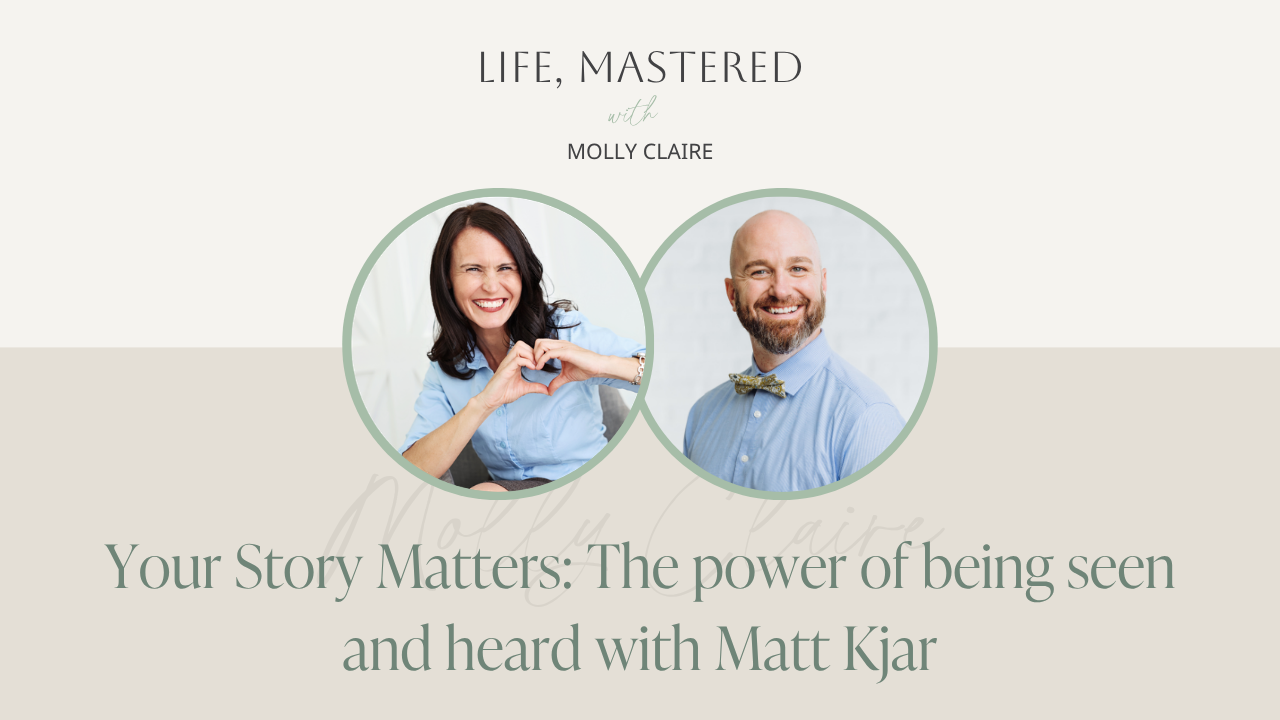
Follow the show:
Apple Podcasts | YouTube Music | Spotify | iHeart Radio | Amazon Music | RSS
Excellent coaching helps people understand themselves, feel their emotions, recognize patterns, and create meaningful change in their lives. But how do coaches communicate the depth of their work in a way that actually reaches people? What does it really mean to be seen and heard beyond simply posting content or recording videos?
In this episode, I’m talking with Emmy Award-winning video producer Matt Kjar about video storytelling, ethical marketing, and how to tell better stories. Matt has worked in television and video production for more than 20 years, including reality television, documentaries, commercials, and Olympic coverage. After he discovered coaching and experienced its impact firsthand, he began using video storytelling to help coaches build trust and create a deeper connection with the people they serve.
Matt’s understanding of the technical side of storytelling and how coaches create transformation changes everything when it comes to marketing for coaches. He knows that the most effective storytelling isn’t just about polished marketing, but staying aligned with your values and being confident while sharing your message.
Video storytelling can be a powerful bridge between coaches and the people seeking their support, helping coaches communicate not just what they do, but who they are. Let’s dive in!
What you’ll learn:
- Why video storytelling goes far beyond camera quality or microphone levels
- How ethical marketing and the intention behind your content matter so much
- Why coaches have to learn to see and trust themselves before showing up for others
- How to access the ability to be seen and heard on deeper and deeper levels
- How storytelling helps coaches connect with the people who need their work most
Listen to the episode:
About Matt Kjar
Matt Kjar helps coaches and entrepreneurs make videos that change business and lives. He began his video and film production journey in front of the camera, as a child actor. He soon realized that the ones who really make the magic happen are behind the camera, so he decided to focus on making magic. He’s had the opportunity to interview A-list celebrities during the Sundance Film Festival, work internationally with the Olympics through 11 Games (He just got back from Italy), and has 2 Emmys from a story focused docu-follow series. Matt is most passionate about helping people change their lives which lead him to become a certified Life Coach. He wants to help you (as Steve Job’s said) put a ding in the universe. 3 fun facts about Matt: He is the 7th of 8 children. He was his high school mascot “Wally the Wildcat,” and could do a roundoff-back-flip with the massive mascot head. He and his wife sold everything they owned and traveled around the US with their four children for a year.
Website: mattkjar.com
Instagram: instagram.com/l.matthewkjar
Facebook: facebook.com/l.matthewkjar
4-part Storytelling Guide: mattkjar.com
Connect with Molly Claire
Get the book: She Rises: Insights and Wisdom from the Women of The Masterful Coach Collective
Molly’s Website: MollyClaire.Com
Master Coach Training 2026 Application Open
Have a question or thoughts about the podcast? Don’t hesitate to contact Molly at:
Molly’s book: The Happy Mom Mindset: mollyclaire.com/book
Free resources:
Please help Molly reach even more like-minded individuals! Simply post a review of the podcast on your favorite platform (or two). It is so appreciated.
Are you a leader, coach, or business owner who wants to inspire, influence, and cultivate lasting change in yourself or others? Unlock your full potential as a leader and coach with the 4 fundamentals of lasting change coach training program.
Apple Podcasts | YouTube Music | Spotify | iHeart Radio | Amazon Music | RSS
Full Episode Transcript:
Molly Claire 00:39
Hey, everyone. Welcome to the podcast this week. I am so over the moon to have Matt Kja here today. Welcome, Matt. Hi, thank you.
Matt Kjar 00:48
Thank you for having me. I love this. Thanks, Molly.
Molly Claire 00:51
This is so exciting for me. I met Matt, I don't know when it was years ago when he was working for the Life Coach School and I was pretty involved there. And I remember chatting, getting to know each other, having lunch in a group together and everything. And then I've also worked with you a little bit in my own business with some video, so.
Matt Kjar 01:10
I still remember that lunch conversation. I think it was a lunch conversation because you were so engaged. Like I remember, uh, looking at you and I'm trying to remember who was sitting next to you, it might've been your sister, but, um, I just remember being like, they're so cool and so fun to talk to. I love this so much. And I was kind of new in the coaching world and I was like, these people are amazing, so I'm so excited.
Molly Claire 01:36
Definitely have a great connection for sure. And a lot's changed over the years for both of us, right? And in the culture world and everything. And one thing, and I admit I am going to introduce you, but the other thing I was thinking is how fun it was to run into you in Paris. So I know you've worked with the Olympics for is it now 20, 26 years since 2001? Is that right?
Matt Kjar 02:06
Yes, since 2002, those were the first Olympics that I ever worked on. Yeah, and I remember getting your message because I had posted something about being in Paris and you're like, I'm here too. It was so fun to like meet up and you found some, because I have a dairy allergy and you're like, I found the best great place that you can go to. So it was just so fun to kind of travel around the city with you for a little bit and just kind of...
Molly Claire 02:32
Yeah.
Matt Kjar 02:33
Like, talk about the Olympics, and it was great. I loved it.
Molly Claire 02:36
So fun, so fun. How often does that happen, right? So anyway, so Matt, now that we've chatted, let me tell you a little bit about Matt. Matt, I want you to tell my audience about you as well. So Matt does video and video specifically for a lot of coaches and he can tell you more about that. But what I love about you, Matt, what I love about Matt and the work that he does is that Matt is also a coach and not just any coach, but a coach who in my experience really understands and desires to continue to understand the depth of the human experience and what we experience emotionally and how the way we think plays into everything. And what I know about Matt and what I love is that he is invested in being a part of implementing powerful change and supporting human beings in just important work in life. So that's a little about Matt, but Matt, tell us more about what you do.
Matt Kjar 03:43
Oh, that and thank you for that. That's very humbling and honored. Like, I feel like when I found coaching, and I was like, wait a second, like this can impact everything. I really I was like, this is this is what I want to help people with, like, helping people implement change. So I've been doing video and television production for over 20 years. And I've worked on everything from reality, television shows, news, documentaries, commercials, all sorts of different things. I've won a couple of Emmys, which were pretty cool, which has been amazing and so fun. But when I found coaching, I was like, wait a second, this is different. And and it happened at a time. So we me and my wife and our kids, we have four kids and we had taken this year long road trip. We'd sold everything and and a lot of that was because of coaching. My wife was involved with some coaches and and was learning about coaching. And so she was like, well, they say I can make anything happen. I want to make this happen. And so we sold everything and went on a year long road trip. Originally, I had the ideas kind of almost like a television show and then she was like, no, we're not going to do that because she was like, I've been on enough production shoots with you to know that if we were if we were out on the road in an RV that you would be out filming interesting things and I'd be stuck with some kids. And then she was like, she came to me and she's like, you remember that idea? We should do that. And I was like, no, we're not going to do that because I was in the middle of that show that I had won several Emmys for, and I was loving what I was doing. And she's like, if we don't do this now, we're not going to do it. So we sold everything hit the road for a year long road trip to go see all 50 states and have we called it an empathy expedition to see what life was like in other people's shoes. And as we were doing that, I didn't realize I learned very quickly how much I put my value into my work, like into the personas into the experiences that other people, you know, were paying me for or I was an external validation, all that kind of stuff. And I very quickly was like, oh, I don't even have to be here. Like she could drive the RV. Like I the kids aren't really relying on me for a whole lot. Like all of a sudden, I had almost an existential crisis. Like, what value am I bringing to the world? What value am I bringing to my life to my family's life? And that's when at that moment is when I found coaching. My wife introduced me to several of the different coaches that she'd been listening to. She'd been in parts of different programs and all of a sudden, I was like, wait, if I can design my life the way I want it to be, I want to have more connection. I want to have more love. I want to have I want I want to be seen.
Matt Kjar 06:52
I want to be heard. I want other people to be seen and to be heard and to tell better stories and so fast forward several years. I came back and we came back from the trip and I did what everything that I possibly thought I could do to try and get into that world of helping coaches with their stories because I felt like that was like if this is as powerful as it was for me, I want to help other people have that same power to be able to understand. Oh, I can like I can feel all my emotions and they don't have to feeling in the depth of emotion and I can also choose the thoughts that I want to think and and I can recognize I can change habits all these different things that that I've been able to learn through coaching. I was like, I really want to act as a megaphone and amplify those people's voices and then as I started working with clients, I was like, oh, it's really about being seen and being heard and telling better stories. And for coaches to be seen and heard, they have to see themselves. They have to hear themselves. They have to recognize, okay, is this something that somebody else is telling me that I want, or is this actually what I want? Is this marketing that somebody, because hey, I'll be the first to say, I know the power of marketing, because I take place and I produce things. And I always am like, I've said this to, anytime I bring somebody into my business to do editing, I'm like, I am gonna, or to produce videos or anything like that, or start teaching clients. I'm like, okay, I am about to teach you some things and this is really powerful and you need to promise me that you're not gonna use it against people.
Molly Claire 08:44
Yes, yes.
Matt Kjar 08:46
Because, they really can't like, it's like video and audio and a lot of those things can almost hijack like can jump over like and speed things through because they are so emotional. They can kind of sometimes like ramrod their way through things. Like I don't know if you've ever experienced this, but I've been like in movies where I'm like, oh, I do not like how I'm feeling right now. And it's almost like I didn't really even choose any of these things. I did choose them because I walked into the movie theater and paid the money to go to the movie. Yeah. Yeah. Anyway, so any time I teach those elements, I also am like, I feel like it's really powerful and important to use them in a way that is for the best of the people on the other side. Right.
Molly Claire 09:37
Right.
Matt Kjar 09:39
But communicating like there's two people, there's always two people and so as part of the communication loop like you have a sender and a receiver and you have a message that's sent and then you have feedback that it's received or that it's not received and being very aware of the other person on that other side you know oftentimes we're the sender being aware of the receiver and being like oh like I want to make sure that I am sending the message that's true to me and then we'll be the best for that person on the other side.
Molly Claire 10:14
Mm-hmm. So much integrity really needs to be in place for us to use marketing tools wisely, right? Like wisely, and I'm like, I'm trying to find the word. It's just like with genuine love and concern for the other persons, like for what's best for them, right? Yeah, yeah.
Matt Kjar 10:37
And it's, I, in my opinion, that's part of the reason why, uh, why we're in the place that we are with, with media and with marketing and all that kind of stuff is because oftentimes, uh, people, and I've experienced, I worked in a news room, I remember, um, the news director coming in and there was a story that was really, uh, there was somebody who was going through something very extreme and the news director came in and was really excited because we were going to break into, um, you know, breaking news. We were going to break into the middle of programming and he, and he was talking about the person who was on the other side of this, who was going through this experience and he was like, Oh, let's see if she still holds her luster. Like, let's see if, if this person is still, um, you know, uh, grabbing enough attention and I was like, that was the day that I was like, I don't want to be here. Like I don't want to be in the newsroom anymore because this is not, like that's not what I'm working towards. I'm not celebrating at the, at the other end of somebody else's tragedy. Um, and, and so like recognizing that's one thing that I always am. I'm always trying to be conscious of is like, what is the, uh, on the opposite side of whoever's sending this message, what is their goal and what are they trying, like, are they trying to, to hijack my nervous system and make me feel, um, you know, triggered or whatever the word might be. Um, and, and then recognize why, and then just be honest, like, there's only one thing that I can do. I can control what I can do. So then I can say, okay, what do I want to hear from this? What do I want to see from this? Um, and, and what do I want to take in and what do I want to let fall by the wayside?
Molly Claire 12:25
Yeah, oh my gosh, we could have a whole episode on ethical marketing, right? And so we'll put a pin in that and we'll maybe circle back another time because I have so many thoughts. But one thing I want to ask you, so you've said this a couple of times, wanting to help people to be seen, heard, and tell better stories. And in video, right, in what you're helping them to produce, they're being truly seen and heard for what they offer, for who they are, kind of the essence of what they bring. And within that, telling better stories to help people understand and probably to help people take action on what people know that they need. Is that part of it? Is that kind of landing? Yes.
Matt Kjar 13:17
And it's so like, it can be, I like to think of things almost like a spiral staircase, right? Like anytime I take in a concept, I learn a new concept, I feel like I'm at the very bottom of that spiral staircase and I keep re-experiencing that concept. And then I get to the next level and I'm like, oh, wait a second. Like I saw it from this level, now I see it from another level and now I see it from another level. So on the surface, very surface level, right? Of being seen, heard, and telling better stories. It's simply like, I want you to be on camera. I want your microphone to sound good. And I want the content that you're telling like a good story. Like that's one of the freebies that I offer is like a storytelling course. But I want you to tell a good story because we operate through stories. But then the next layer is like, you have to be confident on camera to be able to feel like you're seen. And you have to be able to feel like you've seen yourself and really know your message. So that's that next level, right? And then there's like an additional level behind that. So then you have to understand like to see the concepts that you're trying to share with the world. And so it just keeps going deeper and deeper and deeper. So it works on the surface level. Like literally I say, you know, my only job is for you to be seen and heard. And so like, I'll go to an event. And like sometimes this has happened where I go to an event and, and they'll say, Hey, before we start, can you explain to everybody about the cameras and all that kind of stuff? And I'll be like, well, my only job here is for you to be seen and heard. And so you are seen through the camera, you're heard through the microphone, you know, and, but then also, I, and it's funny because like the people that I work with, I always am very cautious about the people that I bring on events and bring, especially when I'm working within a coaching world. I have videos where I have them watch videos in advance and say, okay, we're going to be entering a sacred space. Like when we go into a coaching atmosphere, this is, these people are bringing deep things that are bringing sometimes very hard things. And, and so you as a videographer, like you have the honor and the pleasure to be able to step in the, into this space. I want you to be prepared for that. And I want you to be like, honor the things that they're saying, like be very cautious.
Molly Claire 15:39
Matt, I love that so much. I mean, it's so important because you and I know, right, as coaches, we really are in a sacred space where we get to be a witness of, you know, of someone's struggle, of someone's feelings, of someone's just like everything. I love that so much. Yeah.
Matt Kjar 15:58
And somebody could just be like, well, yeah, because any camera can see you, any audio can hear you, right? So that is surface level, but then there is a depth behind that. And so I've actually one of the guys that I work with, he called me up and he was like, I just love that being seen and being heard. Can I use that on my website? I don't, like I'm not trying to steal your intellectual property or anything, but I really feel like that resonates. And I was like, sure, like I don't own the phrase. Like I'm not putting a trademark on it or something like that because, but I feel like the more people are seen and heard of the better society will be. And when we tell better stories, stories that not just better, like better constructed, that's one aspect of it in the description, but then also better stories to ourselves, better stories to our kids. Like we don't have to continue to rearticulate and perpetuate some of the misnomers, some of the stories that didn't help us in our youth. I love seeing some of those social media videos where it's like, well, if you grew up during this time, you probably heard this phrase and my kids have watched that and they're like, you never heard that phrase and like, oh, I for sure heard that phrase. My dad said that one all the time and they're like, what? Grandpa said that? I'm like, yeah, all the time. And also recognizing that, okay, if I want to tell better stories, I recognize that some of the stories that like my kids might take on and the things that they might have seen me say, some of the past generational trauma, that kind of thing. Some of those stories, like they might leave some of the stories behind that I hold dear. And I can be like, oh, okay, I can see how that might not have, it may serve me, it might've served me and it might not serve you. And so letting them tell the stories that they want to tell as well.
Molly Claire 18:00
Yeah. Oh, I love this. And yeah, you know, I just, I have so many thoughts. I feel like you could, I feel like you could have a coaching program on being seen, heard, and telling better stories, like for a year that could just like go deeper and deeper right into these concepts because it's true. It's like, okay, let's make sure is the camera good? Is the mic good? And is the story put together well, or telling a story that's creating something positive or growth, right? And then also just thinking about from a marketing perspective, right? When I'm putting stuff out there, even if my voice is heard, are things positioned in a way where people can hear what's being said, right? Or are there words, just so many things, right? Can get in the way of people being able to hear. So I love that. And also, and I know we talked about this a little bit, you know, before we started recording, as we were talking about what we were going to dive into is, right, in order for me as a coach, as a business owner, to really have that confidence you spoke about, right? To be confident being seen, being heard, and telling my stories, I first have to be able and willing to see and hear myself, right? I mean, and, and this is the thing, and it's like, you know, in, in Master Coach training, where, of course, I'm teaching, right, about thought patterns, and emotion work, and the nervous system and action strategies, and that's all fantastic. And also, underneath it, and in between it, and woven all throughout, the work I'm doing with my clients is helping them to know who they are, to see who they are, to understand what they need, and what they want, and how do we attend to our needs in such a way that we are the most whole version of ourselves. And I just, I will preach this all day long, that when as we as human beings can really see ourselves, care about ourselves, attend to ourselves, and really have that nurturing, true, like, intimate care that we would give a child that we're caring for, as we do that, we become capable of, and we put ourselves in a position to be of the greatest service to other people, you cannot skip over it, you just can't, you can give, right, someone can, someone can deny their own needs and ignore themselves, and they can do a lot of things, right, they can go do the food pantry, and they can serve here, and they can do a lot of things. But I just believe this, that when we are seeing ourselves, hearing ourselves, validating our worth as a human being and ensuring that truly all of our deepest and most important needs are met, we are at a new level, we have a new foundation, where the type of service and care and connection that we can give people is extraordinary, extraordinary. Wow.
Matt Kjar 21:06
I love that so much because when you have that deeper foundation, it speeds things up. Years ago, I worked on a program with a company called Franklin Covey and they have a book called Speed of Trust.
Molly Claire 21:21
I'm sorry, did you say speed up trust?
Matt Kjar 21:24
Speed of trust.
Molly Claire 21:25
Okay, keep going. Keep going.
Matt Kjar 21:27
Yeah, and um and so we worked on this series where we were talking about how when you trust somebody you like it speeds everything up everything goes faster.
Molly Claire 21:38
It's so true.
Matt Kjar 21:39
And it was it was so fun to watch to edit these videos and to work on this series because they were showing they were showing like different organizations and different big companies and how when the people trusted each other all of a sudden all this friction went away. And the same is true with you as an individual, right? When you trust yourself, it speeds everything else up you're not like, oh should I do this? Should I do that? Should I do this? Like there's so much less waffling and so much less indecision overwhelm all those things that we tend to spin in. When you trust yourself and when you know, okay I am safe like I have safety safety is one of the the biggest things that we as humans are always seeking for. It's one of the things that especially with video it's it's funny because I've seen this so many times when all of a sudden somebody's like oh all of a sudden that little red light went on all of a sudden I knew I was being recorded and all like I froze up I clammed up. I was like What like what's happening there? What's behind that when we trust ourselves when we trust people within like, when we trust our clients, when our clients trust us, when we trust our family members. It doesn't matter who it is when we have that trust and that comes from being seen being heard telling better stories, when we see other people for who they are when we hear them for what they believe and what they want, it allows us to do the same thing for ourselves and it speeds everything else up. It's so powerful to to have that foundation. Just do what you were talking about, like you can't skip over those parts. You can't skip over it. If you do it, you'll always just like that spiral staircase, right? You'll get to that you'll get to this certain level and be like, oh, I did not learn that that way that time I apparently need to keep learning this in a different way and we keep spiraling up and up and up. And deepening our foundation. deepening our knowledge and deepening our understanding of it.
Molly Claire 23:46
Mm-hmm. Mm-hmm. Yeah. Oh my gosh. I love that. And that speed of trust, it's so interesting because another thing that it brought to mind for me is how, you know, one of the, like, the first thing I work with my coaches on is understanding how that coach-client relationship, that rapport, that trust, that sense of safety is going to be the, that is the indicator of if the client is able to change and move forward, right? It is that trust. And I've seen this before, right? When a client comes to me, a new client comes to me, and they already, if someone referred them to me who they trust with their life, they just, like, it's immediate trust, it's immediate comfort, and they feel so safe making that decision, right? I love remembering that, and especially as you were saying, relating it to the trust we have with ourselves. And, like, to those of you listening, what a good moment to think for just right now, like, and without any judgment at all, right? Like, how am I doing as far as how much I trust myself? Like, do I follow through for myself? And again, with no judgment, I can't say that enough with no judgment, right? Do I follow through for myself? And if not, how could I show up for myself a little bit more, right? How can I build that self-trust just a little bit more so I can feel safe in my own body, in my own skin?
Matt Kjar 25:20
Absolutely. Well, and it's interesting because what that does, when you have that trust, and you have that anchor for yourself, and you feel that safety, you're more willing and more ready to talk to people. And that's one of the things that marketing does, is that it does create, like, podcasting is a beautiful form of marketing, because what you're doing is you're offering people a voice, you're offering them a way to hear you and understand you and to know about the concepts. And then they it creates trust with them, right? Yeah, it creates knowledge that like, oh, okay, like they, they come to you and they feel like they know who you are, because you had you've been in their ear for so long. The same was true with video, like when you have a video, when you have content that you're, that you're sharing, that gives them transformation, that gives them a way to say, okay, like, let me really think about the things that that person said, and let me take that in, it breaks through that wall of distrust. So we all have this layer, we all carry this layer around with us. And sometimes it's really, really deep. And sometimes it's not nearly as deep. And, and that's a good thing to have, like, we, we, we all have a way to say, okay, like, is this person safe? Is this person trustworthy? We don't, it's a, it's built into us for a reason to have like to have that judgment and to say, okay, is this safe? Is this a good situation? Like, we don't want that to be gone. But we also don't want to employ in a way that's, that's not helpful. And oftentimes we employ it against ourselves rather than employing it against like, maybe there's a person that's untrustworthy in your life, that you are like, no, I'll put that wall down there. But then, you know, I stopped trusting myself. But with marketing, one of the things that we do is we offer things. And we want to get to the other side of that wall, because we want to help the person, at least that's the way I approach it. I really, I think that when you're offering something, it is to the betterment of that other person to the betterment of their life. And if it's not, then that's when I say, okay, if that's not true, if it's not to somebody's betterment, then I really like rethink what you're offering. Like, if you don't, if you don't feel like this is going to make their lives better, then why are you offering it, like life is too short to offer things to do things that aren't helping everyone else. And not because they don't help you, they're not going to help other people either. But when you see that something has helped you, you can see that it helps other people as well.
Molly Claire 28:16
Mm-hmm.
Matt Kjar 28:18
It's funny because I was thinking about this the other day. My brother-in-law, so this is a good example of marketing. And he doesn't work for a company. He kept talking about the Milwaukee Fastback Six and One, which is a multi-tool. I carry it with me. I'm what he likes to call an everyday carry because he gave me this and he was just telling me how great it was. He's like, it's got a screwdriver with, it's got a razor blade. It's got all these different things. And I was like, when he first gave it to me, I was like, all right, whatever. Things, that's very nice of you. And then he started telling me about all the reasons why he carries it with him every day. Like how I walk up to a door and the handle will be a little bit loose, not even in his house and like anywhere. And he'll be like, oh, he'll pull out a screw driver and fix it. And so he was just talking about this knife and how much he loves it and how much he uses it and how much, like he's an everyday carry, Milwaukee Fastback 6-1 and all this stuff. And all of a sudden I was like, oh, and so I started carrying it. And I started, and this is like, this is a perfect example of marketing, right? Because he gave it to me, I didn't even, I was like, okay, well I'll just try this tool. I'll just carry it with me. And then I was like, oh, hey, that handle's a little bit loose. I pull out my Milwaukee Fastback 6-1 and I tighten the door handle. And then, oh, I need a knife to open this package. And I pull it out and all of a sudden I was like, he didn't realize he was marketing to me, this this thing has made a big impact on his life and so he gave it to me. I think about this like he's not afraid to tell people about how great this knife he thinks how great this knife is because it's made an impact in his life. I was thinking okay I know coaches who coaching has changed everything about their lives and they're they're more afraid to talk about coaching then my brother-in-law is to talk about this $26 knife.
Molly Claire 30:40
Mm-hmm.
Matt Kjar 30:41
Like he's not afraid to tell everybody, like this is the best, right. Like you got to get one of these, he'll buy it and give it to people. Like, and I was thinking about like, okay, so if that little knife has made an impact in his life that he's just willing to just share it everywhere. And yet coaching has made like this huge impact in our lives. We're like, oh, people, like, you know, like saying, like, it's a secret, like it's a, it's a something to be ashamed of. I was like, we got to fix this.
Molly Claire 31:17
Yeah. Well, it's so interesting because, and I think that, you know, when I work with my clients, one of the things we talk about is kind of this idea of like, we're always selling people on something, right? Like him, like when I have something great, I am like, Oh my gosh, you got to try this. It's the best thing ever. It's so amazing. Right. And, and so reminding people, especially the people that say, well, I don't know how to sell, like I'm not good at it. Like, well, no, like think about this, right? There's that. But also as you were talking, and you know, I'm interested in your thoughts on this, but I think that a lot of times the reason that it can feel different to us, right? Whether I'm saying, Oh, like, you know, my, this pen is awesome. You should get it versus this coaching is that we kind of get in our minds, we kind of like intermingle all of these things, all of these fears we have about ourselves. And, and we like mix in our own sense of worth, right? Like, so we have all of these parts of us that we're, that we're wanting to secure with feeling valid as a human being deserving, worthy, accepted, right? And we all have like shaky ground on all of those in different ways at different times. And then we like throw that in the mix and it just, it kind of confuses everything. And, and I think it makes it pretty hard to be clear and to sell, right? And I think that's why this kind of goes back to how important it is that, you know, those of you that are a coach or, or make an impact in your business in some kind of way. And if you struggle with being seen, being heard with marketing, please do not underestimate the importance of, of doing the work with yourself, right? That everything we've talked about, and it just, it matters, I think more than we realize.
Matt Kjar 33:09
It really does. Well, because I think there are two aspects of this, like it's hard for us to not make it mean something about us, especially if it feels like something that we feel really passionate really has changed our lives.Right. Like that in and of itself is hard. Right. I'm sure.
Matt Kjar 33:30
And it should be. It should be personal. If it's not personal, then it really doesn't matter that much to us. And also, it doesn't have to be personal to someone else. Let me clarify what I mean by that.
Molly Claire 33:49
Mm-hmm.
Matt Kjar 33:51
When we offer something, so like back to that Milwaukee Fastback, right? My brother-in-law, it is part of his identity now, right? I mean, you know, people just see him like they know like that's where you're part of the club or that, you know, that kind of thing. But also, when he gave that knife to me,
Molly Claire 34:14
Mm-hmm.
Matt Kjar 34:14
He was like, he was like, what do you think of it? I was like, uh, and he, and he, he said something. He's like, Oh, you just don't understand yet. And I was like, Oh, like when I take that same element, like it is personal to us how powerful coaching can be.
Molly Claire 34:33
Mm-hmm.
Matt Kjar 34:34
And maybe the other person on the other side just doesn't understand yet. Like until I started using the coaching, same with the knife, right? Until I started using it, until I started making it part of my identity, making it part of like what I do every single day, I didn't understand.
Molly Claire 34:51
Yeah. And that has to be okay, right? It's okay if it's not personal to someone else.
Matt Kjar 34:56
And people, there are things that we don't, that other people don't understand about us all day long. Like my daughter hates cilantro because it tastes like soap to her. And I love it. I put it on top of my tacos. I put it on, I put it in my guacamole. And I'm like, well, I don't understand why you don't like cilantro. She's like, I don't understand why you do like cilantro. Like, but it doesn't mean I love my daughter any less. I'm not like, well, if you could just figure out how to like cilantro, then you would be good enough. Then you would, I'm just like, oh, okay. Well, you're not going to like it. And until I actually get to that point where I'm like, it doesn't mean that the cilantro is not good for me. I have a dairy allergy. So somebody could be like, well, you know what? Have you tried this though? Have you tried hard cheeses? Have you tried like, I'm like, no, it closes up my throat and I like start not being able to breathe. So I'm not going to eat dairy.
Molly Claire 35:55
Yeah, yeah.
Matt Kjar 35:56
And I don't make that mean that they're a bad person because they keep saying, do you want these cookies?
Molly Claire 36:02
Yeah. Yeah.
Matt Kjar 36:03
And like, they just don't get it. They don't understand what you can do. Yeah, yeah, yeah.
Molly Claire 36:06
Yeah, of course, of course, right? Oh my gosh, this has been such a good conversation. We're gonna wrap up here, and in just a minute, I'd love for you to let people know where they can find you, and we need the link to the knife, apparently, so we'll put that in the show notes. But I just, I wanna say a couple things. One is, you know, as Matt was just saying, like it is personal to us, right? And it makes sense that some of our own, I'm gonna use this word, I don't know if this is the best word, but kind of some of our own, like insecurities or sensitivities would kind of cloud our ability to really be open and seen and heard. And, you know, one of the things I said was, do your work on that, right? Do your work for yourself with yourself. But as you were talking, I realized I also wanna say that it's okay and it's very normal that that's going to come up for us, because someone could hear this and think, oh, well, I shouldn't let my insecurities get in the way, and I know, like at the end of the day, we're all human. You can't know enough coaching stuff to outrun the human experience. And so it's okay that it's there, but just know it and continue to just attend to the needs that we have, right, to feel whole. So I just wanted to kind of throw that in there. And so anyway, Matt, this has been such a fantastic conversation. Thank you so much.
Matt Kjar 37:41
Oh, thank you. I loved it. It's been- I can talk for hours with you. I think we need to have
Molly Claire 37:46
I think we need to do another podcast episode for sure. So I would love for you to let our audience know where they can find you and anything about your freebie. And then of course, you know, any, any last thoughts that you may want to share.
Matt Kjar 38:00
Yeah. So, um, my website's Matt Kjar. My last name is spelled, K-J-A-R. Lots of people are like, Kajar, Khar, Kahla, I take it all. Like it's not, I won't be offended. Um, but it's, um, mattkjar.com. Um, and right there, you can find the freebie for, uh, the, uh, I think it's a four-part, uh, it's a short video series. I tried to make them pretty quick videos. Um, I have a four-part system of telling better stories. I, and so, uh, that you can get that there. I also have a quiz. I don't know. I don't think that I have that active right now, but I have a quiz. Cause one of the things that people often are like, is what, what equipment should I buy?
Molly Claire 38:52
We'll put all this in the show notes. Perfect. Yeah, yeah.
Matt Kjar 38:56
So that quiz is basically like if you're looking about which equipment you want to buy, it basically asks you several questions about your surroundings, your atmosphere. Because I could give you studio lighting and you could be like oh I don't want to stand in front of studio lighting because it feels overwhelming and so I have all the options there as well. I just really want you to be seen and heard and tell better stories the the work that you're doing the the impact that you can have on the world it's I didn't have to go through coach certification I didn't have to go through coach training I had all of the equipment all of it I had edited the majority of- I've been to several coach trainings before that so I didn't actually have to go through it. Still, I decided to do the work, just like you talked about, for myself, to really get to that depth of knowing and using the tools, and the impact that this work has had on me has been immeasurable in my life. So I really want more people to have this impact in their lives to be able to be seen to be heard to see themselves to hear themselves to tell better stories not just to the world but to themselves because when you show up as your most authentic self, you are making the world a better place for you and for everyone around you.
Molly Claire 40:25
Oh my gosh, thank you so much so much Matt. Thanks everyone for being here. It's like, you know, the, I sometimes say the coaching world is like the Wild Wild West and you got all kinds of flavors of different coaches and there's like, you know, get rich quick as a coach and there's just there's all kinds of things and bringing all of you a coach like Matt, and I know you can hear it I know you can understand why I wanted to have him here. It's just such a reminder to me that the work of really good coaches that are heart-centered who are here to support others in changing for the better is just a really big deal. It's so important. So, thank you so much, Matt. Thank you. All right, everyone. I'll talk with you next time.