





Are Your Coaching Skills Strong Enough to Create Real Transformation?
Mar 18, 2026
Follow the show:
Apple Podcasts | YouTube Music | Spotify | iHeart Radio | Amazon Music | RSS
Whether you’re a coach or simply someone committed to your own personal growth, you most likely know that having the right support can change everything. Thank goodness we have access to brilliant coaches, mentors, and guides—people who can help us work with what’s happening in our minds and bodies so we can transform.
In this episode, I’m talking about the importance of phenomenal coaching skills. If you’re a coach, this conversation speaks directly to the way you support your clients. Coaching skills matter, and the depth of those skills can dramatically influence the results we create.
My early coaching experience was rooted in mindset work and learning how our thoughts influence our actions and shape our results. That framework was incredibly valuable, but over time my understanding of coaching—and my skills as a coach—continued to grow. When I started learning more about the nervous system, emotional processing, and what many would call a more holistic coaching approach to how real change happens, the way I work with my clients changed beyond anything I ever imagined.
I invite you to consider what it means to continue developing your coaching skills—not just today or this year, but throughout your life. When you deepen your ability to support change in others, you also amplify your ability to create change within yourself. The question becomes: how might expanding your coaching skills transform your impact, your business, and the way you show up in your own life? Let’s find out!
What you’ll learn:
- Why the word coaching can mean very different things depending on the coach and their approach
- The difference between being a good coach and becoming a masterful coach
- Why adopting a more holistic coaching approach helps you support clients
- Several questions to ask yourself so you can start to identify coaching skill gaps
- Why continuing to develop your coaching skills deepens your impact and your confidence
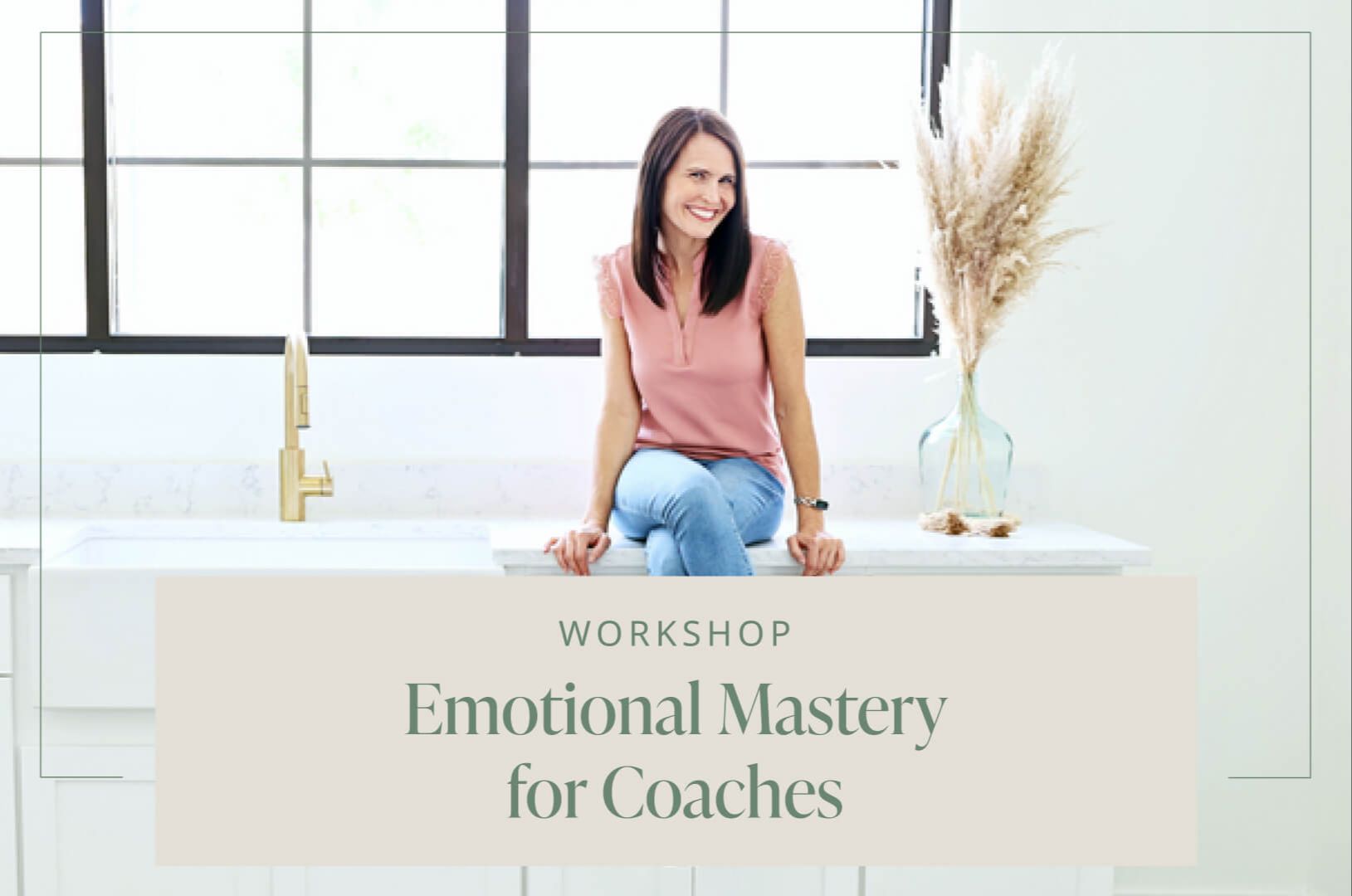
Don't forget to register for my 1-day coaching skill mastery workshop HERE!
Are you craving a moment to breathe, to reconnect with yourself, and to remember what’s truly possible for you? The Spring Reset Retreat is here! SIGN UP NOW for this soulful experience of clarity, healing, and bold self-trust with Molly Claire and Melanie Fay. You can listen to this episode of the podcast if you want to know more about how this experience will benefit you.
Listen to the episode:
Connect with Molly Claire
Get the book: She Rises: Insights and Wisdom from the Women of The Masterful Coach Collective
Molly’s Website: MollyClaire.Com
Master Coach Training 2026 Application Open
Have a question or thoughts about the podcast? Don’t hesitate to contact Molly at:
Molly’s book: The Happy Mom Mindset: mollyclaire.com/book
Free resources:
Please help Molly reach even more like-minded individuals! Simply post a review of the podcast on your favorite platform (or two). It is so appreciated.
Are you a leader, coach, or business owner who wants to inspire, influence, and cultivate lasting change in yourself or others? Unlock your full potential as a leader and coach with the 4 fundamentals of lasting change coach training program.
Apple Podcasts | YouTube Music | Spotify | iHeart Radio | Amazon Music | RSS
Full Episode Transcript:
00:39
Hey there, are you a coach who is serious about giving your clients the best possible results?
00:47
If so, this message is for you. I'm so thrilled to share with you that coming up next week, there is a one-day workshop. It is Master Your Coaching, and we are talking about what most coaching programs do not teach you about how to help your client when they get stuck, when they shut down, or when they are not following through.
01:11
This training is coming through a trauma-informed lens. Trust me, you do not want to miss it. In this time together, there will be four live sessions. All the replays will be available, but of course, being there live will be the best case scenario.
01:27
We're going to dive deep into my four-part framework where we're talking more about advanced cognitive coaching, emotion work, the nervous system, and action strategies that work. We are going to be spending a lot of time together on this day, so we are going to be going deep.
01:45
You do not want to miss this, especially because the price is only $47 for this workshop. You will get access to the replays. I will be there live with you that day. Just to give you a little bit of a look into what you can expect, here are what the live sessions are about.
02:02
Session one will be focused on the future of coaching methodology and why it is important for you to have more of a whole view of your client. It used to be that coaches could have one approach or another, but with our clients and the whole world being more educated about everything, that will not cut it anymore.
02:23
We have got to be trauma-informed. We have got to understand more about how to support our clients through change. Session two is a master coach panel. I will have some of my personally trained master coaches there.
02:36
They are best-selling authors as well, and they will be there to answer your questions and tell you a little bit more about how this nuanced approach is impactful. The next session, possibly the one I am most excited about, session three, is the mind-emotion connection.
02:54
And we're going to talk more about why it is your clients can intellectually get it and still not be able to make those shifts and how you can help them in a more safe and effective way. Finally, session four will be a coaching skills deep dive where you're going to get clarity on your strengths and also those blind spots, because let's face it, we all have them.
03:18
Please do not miss this opportunity. I have to say, I am so lit up about this workshop because I just, I love to dive in deep with coaching mastery with you. I know some of you know my personal story.
03:32
Coaching was so life-changing for me. And as time went on, many of the coaching philosophies and approaches began to actually work against me. My own mind was using them against myself. And it was because of this and because of some very low and challenging moments that I came to understand why at a personal level, it is important that we have more of a trauma-informed lens, why it is important as coaches that we understand more about our emotional world and our clients' emotional world.
04:05
And truly, phenomenal coaching is how we and our clients can not just thrive, but have the type of expansion of self that allows us greater peace, deeper life satisfaction, and greater fulfillment in all areas of our life.
04:24
It is a big deal. I am passionate about it. I'm here to help you. So click the link in the show notes here. You can also visit mollyclare.com to sign up. Hope to see you there. Now let's go ahead and dive into this week's episode.
04:39
Hey, everyone. Welcome to this week's episode, Life Mastered the Podcast, where we are talking about how to master our lives, how to support others in that journey for those of you that are coaches. And today on this episode, we are talking about the importance of phenomenal coaching skills.
05:01
So some of you are coaches, and this is obviously directly related to the way that you support your clients. And obviously, this is applicable to all of us here as people who are seeking to grow personally.
05:15
And for those of you who hire and work with a coach, which I hope is every single one of you. Sometimes, you know, a friend or a colleague will joke with me and say, I need coaching. And I always say, yeah, me too.
05:28
Every day until the day that I die. Thank goodness that we have access to brilliant coaches, mentors, guides, people who can help us work with what's happening inside our mind and our body so that we can grow, so that we can transform.
05:45
So that's the topic today, coaching skills. They matter. As we're diving into this, make sure that you click the link in my bio. I am doing a one-day workshop. It is a coaching mastery workshop. It is going to be focused on really how to have masterful coaching and the framework that I teach, the four-part framework.
06:06
It's going to be a phenomenal event. I'm also going to be offering a coaching skill mastery intensive that is going to be a more involved training program coming up. So make sure that you are there for the live workshop.
06:20
And I am so excited to be able to invite so many of you into a more advanced training container where we're able to go much deeper. So it's not the full master coach training, which is a year-long, but it's really an opportunity for you to dive in and enhance your skills.
06:38
So click the link in the bio. That is coming up. For today, let's talk about coaching skills. Now, coaching, it's an interesting word, right? What does it mean? And I know when I first found life coaching, I had no idea what this was.
06:53
I did not know this was a career. And in particular, my exposure to coaching was mindset coaching. I started with the life coach school and it was very much the CTSAR model, right? Understanding how thoughts create emotions, drive actions, create results.
07:09
This was the model that I followed. And I have a lot to say about that because, of course, since then, my view has expanded as I've understood more about how the mind and emotions, how everything fits together and more about the nervous system, et cetera, which we're going to talk about.
07:25
But my first exposure to coaching was really a coaching model or methodology that was more of a causal coaching, not just I'm going to give you advice, I'm going to give you guidance, we're going to have accountability, but a much deeper dive into coaching.
07:41
And so in my mind, that's what coaching was. And that's what I thought everyone thought coaching was, is that coaching was more diving into what's going on in your mind and really making shifts internally.
07:53
Well, of course, that's not everyone's view of coaching. So I first want to acknowledge that the word coaching means very different things to different people. Sometimes a coach is someone who holds people accountable, who helps them move forward, who holds their hand through things.
08:08
Sometimes a coach is more of a mentor, giving advice, giving cognitive reframes. And sometimes coaching is more of the deep dive, emotion work, et cetera, et cetera. So coaching, very broad term. What does it mean to you, especially as a coach?
08:24
Those of you that are coaches, what type of coaching do you do? What category do you fall into? So as we dive into this episode, I am advocating for having incredible coaching skills that are more expansive.
08:43
So what this means is that I am a firm believer that no matter what type of coach you are, whether it is more giving guidance, giving advice versus a very curious, kind of open, working with emotions type of coach.
08:59
I'm kind of having these two categories, right? Either way, I believe it is vital that you are always deepening your understanding of how to work with people. So I'm going to give you an example. One of my clients in master coach training is learning, taking a deep dive right into all the deep coaching mastery skills.
09:22
And on a recent call, we talked a little bit about the difference between that and the work he typically does with clients because he's not a life coach right now, but he works in finance and he helps people to look at the facts and figures.
09:36
He looks at their numbers. He looks at the profitability of their business. And he was talking about, we were having this discussion about how do these softer skills, how do these deeper skills, like understanding emotions and working with the mind, how does that really fit if you're just looking at facts and figures and putting a plan of action together?
09:56
And as we talked about it and we sorted through the numbers he's looking at and the recommendations he makes, we talked about this idea that when he gives the client a plan to follow, he has now given this client a circumstance or a plan that they are now going to have thoughts and feelings about.
10:19
How eager are they to implement this plan? What kind of fears do they have? What kind of hesitations do they have? And so even if you are the type of coach that is very practical, very tangible, giving plans like strategy and action plans, being able to understand how the human mind works, how the human body works, more about the nervous system is going to help you be the most effective.
10:52
Okay. So having said all of this, when I came into coaching, I've learned very much mindset and I'm so grateful for my particular coaching path because as I started my business, I'll be honest with you, I latched right onto the coaching concepts.
11:08
I felt really confident as a coach pretty quickly. It was very natural to me. And I really wanted to focus on the business building, which I did. But part of the process of me doing that is I did a master coach training program.
11:23
And as I did this, I'll be honest, I was pulled in because I knew that the marketing and business was a part of it. But what I didn't know is that I would actually be deepening and expanding my coaching skills to an incredible degree.
11:38
And I didn't realize until I did that just how much I was lacking. And this has been my experience over and over again. And it continues to be. Every step along the way, I realize I learn there's more to learn when it comes to being a masterful coach.
11:56
There's more to learn when it comes to understanding what your clients are facing, what's hard for them, how to work with your clients. And one of, I think part of the reason that I'm just like so passionate about the work of coaching mastery is it feels like an art form to me.
12:15
It's like, because when we have this understanding of the mind, of the nervous system, understanding stress responses, understanding that sometimes our client needs us to be with their emotions. And sometimes the client needs for us to give them a plan of action.
12:35
And other times the client needs help in looking at their thought patterns. And other times our clients simply need us to help them regulate their nervous system. When we understand this, it is so much fun to be able to truly ebb and flow and move with the client.
12:57
And so I'm super passionate about it, obviously. And today I really want to get you on board with this idea of how can I deepen my skills, not just today, not just next week, but for the rest of my life?
13:11
And how will deeper coaching skills, a greater ability to help people implement change? And by the way, a greater ability to help you implement change. How is this going to change your life? How is it going to change your business?
13:25
Okay. So this is what we're talking about. I want to talk about what I would say are traits of a good coach, which by the way, is a good thing, is a great thing, right? We all start somewhere. And having a good coach is fantastic.
13:40
We're going to talk about a good coach versus masterful. So a good coach is someone who is going to ask powerful questions. Okay. Really good skill to tighten up. What are powerful questions? How do I ask them?
13:55
And how do I ensure that these questions land with my client? A good coach is often going to bring accountability, structure, right? A goal-setting process potentially. A good coach is going to help with powerful mindset shifts, reframing, right?
14:13
A good coach is going to be able to make progress with their clients. All fantastic things, right? Now let's talk about a masterful coach, taking your coaching to the next level. Coaching mastery is about being a coach who's trauma-informed and understands how to recognize a trauma response in your client, how to be safe.
14:43
Coaching mastery means nervous system literacy. I had no idea about any of it when I started coaching. No idea. And how different my approach is now and how much more effective and safe and gentle I'm able to be is mind-blowing to me.
15:02
And I say gentle, but the gentleness is required for the big powerful shifts to happen. So that's the second one to consider. Really fantastic deep coaching requires nervous system literacy because we all have a nervous system and the nervous system is the backdrop of all of our thoughts and feelings.
15:23
And our nervous system helps us to have patterns of behavior, right? And we're all trying to change our behaviors, make shifts. Masterful coaches understand emotions and have emotional processing skills.
15:42
And I want to make it clear and differentiate between the nervous system and nervous system literacy versus working with emotions within our client because they are different. Now, they're not separate, right?
16:00
But they are different skills. And the way you can be masterful as a coach and create deeper transformations, greater movement and be able to work through resistance is by having that emotional literacy and emotional processing skills.
16:21
Which brings us to another point in terms of deep coaching mastery, which is the ability to work with your clients through the resistance, how to address shutdown. And part of this is understanding how the nervous system comes into play and where there are emotions that need to be processed.
16:48
So coaching mastery, deep dive coaching, I'm able to work with the resistance. I'm able to create a safe and supportive experience with my clients so that we can continue to move and flow forward. Okay.
17:05
Masterful coaching means deeper pattern interruptions. We all have patterns. We all have patterns of behavior. And we all have emotion patterns within us. We all have thought patterns within us. Many of them, most of them, I'm going to say, I don't really know how to easily access.
17:33
And there's a lot of power as a coach in being able to create that safe space and to be able to be with the client in such a way and ask the questions in such a way that we are able to really reveal so much of what's going on underneath.
17:58
And not only reveal it and bring it to light, I'm going to say, but to also bring some perspective to be able to see and understand the patterns for what they are and then support the change within. Another thing to consider when it comes to this masterful coaching, this deep dive coaching, is sustainable transformation.
18:24
And that's like the word that I came up with, but it honestly doesn't land as far as what I'm really trying to articulate. Yes, sustainable change is fantastic. And really what I'm talking about is that when you, as a coach, can constantly be immersing yourself in learning about the mind, about human behaviors, about the needs and desires of our hearts and our souls and our longing and our emotions.
18:59
We are able to create a profound, deep transformation. I am a product of this very exact, deep transformation because I had a coach, I have a coach who has taught me how to care about my own feelings, how to be with my own feelings, how to give myself the support and space that I need around my emotions so that I can feel safe enough to grow and evolve.
19:39
These are things I never would have known, never would have learned, had I not worked with a coach who was so committed, is so committed to her art and craft of holding space for me as a human being and all of my emotions and all of my fears and all of my struggles.
20:06
Had it not been for her devotion, I wouldn't be where I am today, which is a place I'm really proud of. And I know I've shifted the conversation a little to me, but I say all of this, not as someone, you know, above or standing on a pedestal or just being a teacher and spouting this off, but truly, every day, I think we all have the honor of experiencing the deep level of transformation that we offer others.
20:36
And every single day, every single day, genuinely, I feel grateful to feel alive in my own life, to know that I have choice, that I have authority over my own life, to be able to feel a sense of peace, to understand who I am and what I want and what I need and how to be my own best support as I bring my dreams and my life forward.
21:06
It's so powerful. It is such a big deal. So I want you to take this in. I want you to think about this. I want you to think about what is the power in you being more capable as a coach? What is the power in you being more knowledgeable and supported in your own personal journey of growth?
21:39
What would the difference be? And from a business perspective, for those of you that are coaches, it makes it a lot easier to sell and market your services when you know in your bones this is going to change someone's life.
21:57
I have zero hesitation. If anyone is ever considering hiring me, it is very easy for me to tell them that they should do this. Now, not if I believe they should be referred out to someone else, right?
22:11
It's not the same thing. But I don't have any doubts that someone is going to be drastically different at a fundamental, deep, and spiritual level after our work together. Not because of me, but because I know that I am able to engage in this powerful, deep work in a way that works.
22:34
And I know the same is possible for every one of you who have a heart for change and impact and you want to do the work and you want to help others. So business-wise, a lot easier to sell, a lot easier to have renewals, a lot easier to have referrals.
22:54
It makes a difference in terms of impact, in terms of integrity. It feels pretty good to know that you are bringing this level of expertise and mastery and safety and care to your clients, period. It is a powerful thing.
23:10
It is a powerful thing. In terms of you and your own personal life, oh my gosh, how many times have you been, you know, beating your head against the wall, trying to implement change for yourself, trying to figure out the best way of thinking, trying to figure out how to change your habits.
23:29
We spin and spin and we swirl and we blame ourselves. Wow. What if we could have more of an understanding of our brain, our body, our nervous system, and what we need to support ourselves in actually making permanent change.
23:47
It is everything. Okay. I'm going to flip my little chart here. I've got a few questions for prompts just to help me remember and stay on track. Questions for you to consider as a coach. Where are your skills lacking?
24:03
I'm going to go through these questions. Where do you have room to grow? As a human being invested in your own development, where are your skill gaps? Okay. So question number one. How capable are you of providing the type of support your client needs when big emotions arise?
24:24
Do you understand those big emotions? Do you understand the difference between big emotions and a stress response? How confident and capable are you in that space? As an individual, how comfortable and capable do you feel with your own big emotions?
24:45
Another question. Do you recognize trauma responses? Do you have more to learn here? Do you have more to learn about yourself? Oh my, I can say there are ways that I was showing up in a stress state that I had no idea until I learned this.
25:00
I always just thought that, you know, I think of like, oh, overworking, right? I'm just overworking. Guess what? That can be a manifestation of the flight response. Learn your nervous system. Understand it.
25:13
Okay. How well are you able to work with resistance when it comes up for your clients? How well are you able to work with your own resistance? Do you get frustrated? Do you push against it? Notice where your gaps lie.
25:30
Are you confident that you can help the people coming to you? And are you confident knowing when you need to refer out? And I think that what I will say in general is as I train my coaches and my master coaches and they become more, more skilled and well-versed, there are a lot more people that they actually know they can help.
25:52
And it's also very clear to them when they need to refer out. Okay. And sometimes it's not an either or, right? Sometimes it's both. How are your skills in being able to build emotional capacity and resilience in your clients?
26:10
Really important skill to have. One of the most important skills to have, I'm going to say. Okay. And the last question for you to consider. When it comes to mindset work, when it comes to utilizing the power of thinking and belief, are you able to do that work effectively?
26:33
Are you able to do that work safely? These are a few questions for you to answer. In case you haven't gotten the message quite yet, having amazing coaching skills matters. It matters. It matters in terms of your confidence, in terms of your impact.
26:54
And it matters. Right now, people are more well informed than ever. There are a lot of coaches. And the question is not, are there too many coaches? It's, am I a phenomenal coach? That's the question I want you asking yourself.
27:07
Am I a phenomenal coach? Thank you for being here. Look at your skill gaps. Continue to fill them. Continue to learn. Continue investing in your own personal development, your professional development, your coaching skill mastery development.
27:24
And I hope to be a part of that journey. Hopefully you're all going to be live on the upcoming day-long workshop. The work we do matters. We are supporting human beings in the growth and transformation of their heart and soul.
27:40
What better work could there be? All right. I'll talk with you all next week.