





Self Connection is the Key to Masterful Coaching with Maria Hendershot
Apr 22, 2026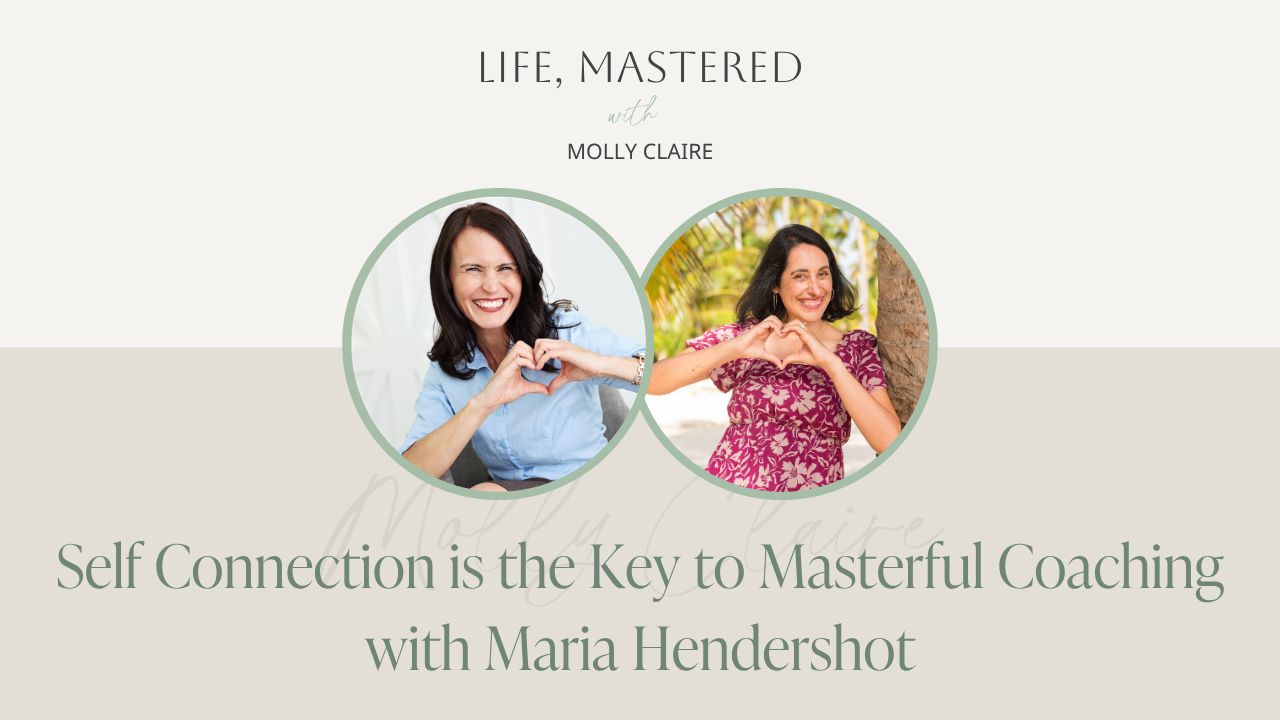
Follow the show:
Apple Podcasts | YouTube Music | Spotify | iHeart Radio | Amazon Music | RSS
Self-connection is at the heart of holistic coaching. In order to see the whole picture of your clients as human beings, you have to understand your own mind, emotions, and nervous system and how they impact you both personally and professionally. Even if you’re not a coach, connecting to yourself is essential to connecting more deeply in your relationships and with the world around you.
That’s why I am so excited about this conversation with Master Coach, Maria Hendershot. Maria and I have known each other for a while and have worked together in different capacities, including as co-authors on our best-selling book, She Rises. She took part in my holistic Master Coach Training program, and I’ve had the opportunity to witness her become so masterful in her ability to articulate coaching concepts that truly help others transform.
Like many of us, Maria was initially trained in a cognitive approach focused on how thoughts create feelings and shape our results. Through deeper training, she began to understand what was happening in the nervous system, what was getting stored in the body, and why patterns get recycled. Today, you’ll hear how that understanding opened a whole new space for growth, both for herself and for the women she works with.
As you listen to this episode, I hope you take in how important it is to be kind and gentle with yourself, and to really see and accept all of you. When you can do that, you create space for greater wholeness, deeper self-connection, and more meaningful, lasting change in your life and in how you support others. Let’s dive in!
What you’ll learn:
- How Maria combines different methodologies and tools to support transformation
- Why a mindset-only approach can only take you so far before it starts working against you
- How self-connection impacts your ability to create change in every area of your life
- How Maria uses her training as a Tiny Habits coach to support aligned action
- Why celebrating small wins isn’t frivolous, but essential to shaping new patterns
Listen to the episode:
About Maria Hendershot
Maria Hendershot is a master certified life coach and health coach who helps overwhelmed midlife women feel like themselves again—and become the woman who achieves her goals. Through her work in mindset, emotional resilience, and whole-person wellness, she teaches women how to create lasting change without burnout. As a homeschool mom of six and founder of Joyful Reinvention, she brings a grounded, real-life approach to personal growth through her 90-Day Joyful Reinvention program. She is also an international best-selling author and host of the I’ve Got You Mama podcast. You can connect with her on Instagram or through her website.
Website: joyfulreinvention.com
Instagram: instagram.com/mariahendershot.coaching
Podcast: podcasts.apple.com/us/podcast/ive-got-you-mama/id1870480469
Maria is offering 50% off of her Joyful Reinvention 90 Day program to the first 3 women who apply for a 90 day transformation experience or an annual plan with the code JOYFUL50
Connect with Molly Claire
Get the book: She Rises: Insights and Wisdom from the Women of The Masterful Coach Collective
Molly’s Website: MollyClaire.Com
Master Coach Training 2026 Application Open
Have a question or thoughts about the podcast? Don’t hesitate to contact Molly at:
Molly’s book: The Happy Mom Mindset: mollyclaire.com/book
Free resources:
Please help Molly reach even more like-minded individuals! Simply post a review of the podcast on your favorite platform (or two). It is so appreciated.
Are you a leader, coach, or business owner who wants to inspire, influence, and cultivate lasting change in yourself or others? Unlock your full potential as a leader and coach with the 4 fundamentals of lasting change coach training program.
Apple Podcasts | YouTube Music | Spotify | iHeart Radio | Amazon Music | RSS
Full Episode Transcript:
Molly Claire 00:39
Hey, everyone. I am so excited about this conversation with Maria Hendershot today. I'm so excited that you are here listening. I have to tell you the reason we're here recording this is that Maria is a master certified coach. She trained in my holistic master coach training, and I have just witnessed her. I don't even know how to articulate this. I don't want to say like coming into her own and really becoming so masterful as a coach and in her ability to articulate these coaching concepts that really help us as human beings to transform. I was having a group call with my clients and I invited alumni and Maria was there. My mind was like blown by the insight she was sharing. I just said, Maria, we got to have you on the podcast. That's my long explanation of why Maria is here. Maria is master certified. She has many other certifications and trainings she can tell you about here. Really, we're just end coaches. It's important that we understand the whole picture of ourselves as human beings, our mind, our emotion, our nervous system, how that affects us personally, how that impacts us as a coach, and you're going to hear about her transformation. That's what we're going to do. Welcome, Maria. Thanks for being here.
Maria Hendershot 02:08
Thank you so much, Molly. It's such an honor, truly. I'm so excited.
Molly Claire 02:12
So fun. And Maria and I have known each other for a while now, and we work together in like a couple of different capacities. Maria, you were one of the authors in our best-selling book. She rises, which is so fun. Yeah, I love that. Yeah, and those of you listening, you definitely need to follow Maria because I'm sure a part of you is dying. It's like it always feels uncomfortable, right? It's like, oh, everyone's watching me, but her reels are so awesome, and Maria, you just have such good energy and your joy and your fun and your willingness to just be who you are, and embrace where you are is beautiful and inspiring. So I think everyone should follow you I always love love love watching your reels.
Maria Hendershot 02:51
Oh, thank you. You're so sweet. I love it.
Molly Claire 02:54
Okay. So tell us, I have some questions I want to ask you, but just tell my listeners, who are you? You know, a little about your background and what you do professionally.
Maria Hendershot 03:05
Yeah. So, I mean, my background for the last couple of decades has been a homeschool mom. That's where most of my energy and time has been spent. And then I got introduced to coaching. And it was actually my kids who are like, mommy, be really good at this. And I was like, because I want to be really good at this. And so then I got into coaching, I got certified. And I initially was helping homeschool moms, which I still do. And they're typically like their teens. I'll do some teen classes. And most of my initial training was all cognitive. It all starts in the thoughts. And the power of mindset was so powerful. It truly changed my life. And I've seen it change other people's lives as well. But what was interesting was that it moved me to a point. And then I got stuck again. I did not understand what it was. And I think at this time, this is when I met you. Well, I didn't meet you. I knew of you. I had done a couple of programs, but I had been introduced to your master training program. And I didn't know why I just knew. I was like, I just need to do this. I didn't know what exactly it was. I just knew I needed to be part of it. So I jumped in. And that is when I learned all of these missing pieces that I did not know about before. Even though we talk about both you and I were trained initially in the model. So thoughts create feelings and leads down to our results, right? But even then, I did not even learn what was happening in the brain for that process to happen. On my own, what was happening in my nervous system. I had no idea of those things. And so being introduced to that, being introduced to the idea of what's getting stored in our nervous system, why our body reacts so quickly to things, patterns that get recycled, understanding all of that, it opened a whole new space for growth, for being able to help my clients. It was a missing piece that I needed and it has just been amazing what it has offered to both myself and the women I work with. So right now, I mostly work with middle-aged women, women who are in the thick of it, moms who are in the thick of it, trying to juggle all the things and their bodies changing. Maybe they're still, I know for me, I know it's like my life is still very busy with mom things, but I also am starting to transition to this place where I have a little bit more time to rediscover myself and to bring up things that I've kind of put to the side because I wanted to spend my energies on and my focus on being a mother. And now I have a little bit more time and I can like give myself a little bit more time. So you separate from mom. Yeah. And it's kind of been fun to just reacquaint myself because younger me, even when I had that time, I was, you know, sometimes we're just socialized to quiet ourselves down. I remember always kind of feeling like I was trying to figure out the game of like, what was acceptable? And I'm in this beautiful place where I can just find out who's me and I already know that it's acceptable.
Molly Claire 06:35
I love this. And so I want to highlight a couple things because, so taking a step back. So, you know, Maria just shared how thought work, right? A mindset approach. I know a lot of you that follow me, obviously we're in, like we're all into like improving ourselves, right? Mindset matters. The way we think matters. Our beliefs impact us. This is all true. And what Maria just shared is something I have shared over and over again. And we'll keep saying is that it can move you so far. But when that is the only thing we are focusing on in our personal development and as coaches, we will get stuck. And not only will we get stuck, but we can start to move in my experience backwards in our journey of healing and wholeness and expansion, right? Because what was working for us now begins to work against us, which we can, talk more about. But I want to highlight that because those of you listening that have been really focused on, you know, thought work, mindset, you know, belief frame shifts, all those kinds of things. If you've experienced this, you're not alone and there's nothing wrong with you. It's normal because there's a lot to understand about human biology and psychology. So I want to highlight that. But the other thing I want to say, so Maria, so you trained at the cognitive model and then you also trained as a tiny habits coach, which is talk about that. Is that really pretty action-focused?
Maria Hendershot 08:03
It is. It is action-focused. So when you're talking about like all these different models and all these different methodologies of coaching and self-growth, it's like a toolbox, right? And if we walk around just with a hammer, it's just limited what we can do, right? And we might do some damage where, you know? And so just putting different tools in is just so helpful. And I feel very blessed that different ideas have come into my way and putting them all together has just really clicked.But yeah, Tiny Habits is really this idea. It was developed by BJ Fogg. He's a Stanford professor on like human behavior. And he talks about really like the action part. Like when you talk about aligned action, this is a tool that helps with aligned action. And so it is starting with like the tiniest baby step and focusing on that. So oftentimes it's like, okay, what are things that you already do every day without thinking about it? And then what's the new behavior? And does it fit in as like, okay, we have a prompt. We already always get out of bed, right? We always get up in the morning. So could we add a practice of gratitude or just it's going to be a great day to that act? And then his big thing is celebration. And I love that. I feel like I've become the queen of celebrating.
Molly Claire 09:33
I know, it's so awesome. And your celebrating has been so good for our Master Coach community. It's like one of the gifts that comes from the Maria Energy. It's the best.
Maria Hendershot 09:43
I love it. Well, it's part, it's hard for people. A lot of people, it feels awkward for them. And if you don't understand the biology of what is happening in your brain, it seems frivolous. Like, Oh, I don't have time for that.But it's actually the secret sauce to it. It's like, let's celebrate. And now I just want to celebrate everything. Like I, I'm always looking for ways to celebrate.
Molly Claire 10:06
Mm hmm. It's the best. It's the best. I mean, that's something.So in master coach training in our community halls, right? One of the things we do when we do our 90 day planning is we set out, OK, when you hit these milestones, how are you going to celebrate? And it's just like Maria said, it's surprising, you know, even, you know, those of us in this personal development world that that, you know, we quote unquote should understand this, it can be really hard for people to do that. And so I love that you're emphasizing that. And again, it's not frivolous. It's actually something that's going to reinforce the behaviors you want, reinforce the growth, the achievement, right? And in a really powerful way. Yeah.
Maria Hendershot 10:45
And, and really it's important to remember that through all of this, the becoming is what the point is, right? Like the end destination, that's awesome and like big celebrations when you get to whatever the end destination of the time is, right? But what's beautiful is the process of becoming, learning, like gaining the confidence, connecting with yourself, realizing that you can do hard things, that you are building connections, that you are learning about yourself and strategies to overcome different things and building resilience. And if you're not celebrating those little things along the way, it's almost like you miss out on a whole part of the journey. It's kind of the point really, like if we can't have fun while we're doing it or appreciation or gratitude or whatever those positive emotions that you're craving, yeah, you're missing out on so much of the big picture.
Molly Claire 11:43
Okay. And I want to pause here and highlight this as well, because I know I'm speaking from myself personally, and I know a lot of my listeners, when we've been so focused on achievement, right? And achievement as the way we feel good, achievement as the way we're accepted, as the way we feel safe, as the way we think, okay, I'm okay, right? When we've thought that way for so long, it can be really hard, not only to slow down and pause and celebrate, but to really understand the value of it. And so I want to say this, because those of you listening, if you relate to this kind of like, well, it seems frivolous. Well, that's nice. But let me tell you that I relate, and this is just like a good time to remind us, like how valuable is just our experience of life, right? How we experience every single day, how well we're able to be connected to the people that we love, how much we're able to access a sense of deeper peace and purpose and meaning. And so like, what a good moment to remember. That's really what we're all wanting. We're trying to go about it different ways. And, and truly that presence and that appreciation of the moment and that celebrating is, it matters just in its own right.
Maria Hendershot 13:17
It matters. And it's actually going to bring that progress even quicker because of just the energy we come to life with.
Molly Claire 13:28
Yeah, yeah. Okay, so as we move through this conversation, I'm excited to dive in with you a little bit more about the holistic approach to coaching. So Maria, you start with a cognitive model, you do the tiny habits training, you're obviously a rock star coach, emotionally intelligent, on the ball doing this for yourself. And then I know that I remember specifically a conversation with you on zoom, where you had said, when you found holistic master coach training, you weren't really sure what it was, but you knew you needed to learn from it, you just felt it and felt compelled to. And then I know since then, and you've talked a little bit about this, how understanding our emotional world, right, and I'm kind of adding to what you've said, because I think these are all relevant for those of you listening to understand that your emotional world and understanding your emotional needs, it really matters. Understanding the ways in which you have some triggers where you have this nervous system is saying, hold on, right, stay safe. And we go to a state or fight or flight, understanding that matters. And understanding how the mind, the emotions and the nervous system and the patterns that we develop, understanding how all of them fit together is how we create growth and progress. And, and this is the part on top of that, within all of that, what we are doing as we acknowledge all of those things is we are really, truly honoring, respecting and appreciating ourselves as a human being. So let's talk a little about that. Because we talked about that before we came on camera, right? A little about just that ultimate acceptance of self. And I think that's one of the most beautiful parts about all of it. So I know this, I didn't really ask you a specific question. I just said all these words and then I just said, say something. Well, I have something.
Maria Hendershot 15:40
I have a couple ideas. One, just about the different parts of it, of just whole person wellness. Because I've also, besides like nervous system, like tapping and cognitive and emotion work, I also have like a health coach certifications too, because, so a friend of mine, she told me, and I've been using this myself for a while now too, is that the best way to help your body is to help your mind, and the best way to help your mind is to help your body. And those are just two parts of it, right? But it's really true.It's kind of like, I don't know, I like to work in analogies, and I have two analogies for this. One is like, when you're tightening a tire, and you can't just do all one, and you have to do one, and then one, and then one, and then one. You know, you're kind of going to the different parts. Another analogy is like a 3D puzzle, where it kind of just all start shifting until it clicks, but you kind of have to mold all parts. And that's one thing that this has given me is, even just awareness that there's these different parts helps me know where the entry point might be for either me or my client. And that can be really, while having it in the background, that there may be other things going on too. And that just opens space for grace, and grace opens up space for growth. Because if we're constantly beating ourselves down, it's just hard to move out of that spot, right? But when it just, when we give ourselves some space, and that grace of being like, okay, that makes sense, it may still not be a quick transformation, but at least we can say, okay, I understand that why this is happening, maybe why I'm stuck, or why I'm feeling not great. And we can start seeing some ideas of how to move forward. Now, on the other hand, the second thing you talked about was this importance of connection with self. And I mean, I truly think that humans crave connection and fulfillment, purpose, like doing something that matters in the world, leaving an impact. And, you know, a sense of joy and fulfillment and wholeness, right? And I just really, truly think that connection with self is at the top of those things, because- 100%. Yeah, you can't really connect with other people with a higher purpose, with nature, if you are really disconnected with yourself. It seems to be like that seems to be the thermostat of deciding how much connection you can get with the world is how connected you can be with yourself. And truly, we are kind of socialized to disconnect from ourselves a lot. Absolutely. Yeah, so learning how to reconnect is just such a key foundational part of all of those other things that really create a fulfilling life.
Molly Claire 18:47
Mm hmm. Yeah. And I want it. So I want to speak to actually this holistic approach and the relationship between the self connection, because, you know, when I talk about like the work that I do and what I teach here, it's like, OK, the four fundamentals. And the other thing is the self connection. But they're not they're interconnected. They're one in the same because and so I want to actually take a step back and speak to your analogy about like just tightening, you know, one screw on the, you know, tire or whatever. And I think and the idea to have different entry points, because that's the thing is like we can be trained to understand more about the mind. We can be trained to understand more about the nervous system habits. Right. And I think they're all valuable. And this is one of the things I love about, you know, the holistic master coach training program is we're looking at all of them and understanding how they fit together and getting a better idea of when and how to have one certain approach with any one given client. Because I could meet with Maria. I could be coaching you today and we might, you know, go in at a cognitive level. And then we may need to switch completely to the emotion space. Right. And another day it could be totally different. And so there's so much value in, you know, especially those of you that are coaches, educate yourself and keep educating yourself over and over again. Right. Learn the different tools and understand how they all fit together. And so there's that piece. And then when we talk about this self connection. If we think about this. If we are trying to fix our life or our emotions with our thoughts or mindset, which you and I have both tried to do at some point in our life. Yeah. If I'm trying to do that, I am usually minimizing or dismissing some of my emotional needs. There's a part of me I'm trying to push out of the way, which is not really full self acceptance. Right. And then if I'm having maybe I'm in a bit of a fight or flight stress state. And maybe I'm I'm a little emotionally activated, not crazy about my behaviors. And then I start criticizing or judging myself for that. Well, first of all, that's not going to help me get into a more calm, grounded, connected state. But also I'm criticizing and rejecting a part of me. And so I think part of the magic in this holistic approach where we're learning the mindset, the emotional world, the nervous system, the habits is not only are we learning these different entry points, but we're saying all of these parts of us matter and wherever we are needing time and attention as a human being, that's okay. And when we can make that space and that grace for us to be human and have all of these parts of us, it is, I just feel like it just lays down some of these judgmental, harsh, critical views that we can have of ourselves that disconnect us. And when we can lay those down, it is knowing of self, accepting of self. And within that deeper sense of peace, like Maria, like you said, this is when and how we can really be present for everyone else in our lives, right? Our relationships, our purpose. It's just, it's, it's everything. Yeah.
Maria Hendershot 22:32
And I also think, because I think humans also, we talk about getting caught in this like needing to be productive and achievement and stuff. And I, cause I've wrestled a lot with this because I've always seen myself as the go-getter and I'm like, well, where does that fit in with all of this other stuff? And it's just taken me a little while to understand how it fits together. Cause I'm like, well, should I not try to do that? But deep down I believe that that is part of human growth to like, we want to see what we're capable of, right?Like, I feel like that is part of being human. What I, another analogy, like I've seen my children are all parts of sports and I've seen, you know, coaches that coach from a place of we've just got to get the win. We've just got to get the outcome and it can kill the love of the sport. It can break spirits so quickly, break confidence so quickly. And then I see coaches that come from a place of, like they know how to push hard, but it's from a place of like, I know what you're capable of and we're going to get you there. And there's just this different energy that comes from the different approaches. And one is obviously so much more effective than the other one is only going to get you so far. And then it's like, I don't even want to do this. This is not fun, right? And I've kind of learned to transfer that into my own life of there has to be room for understanding where I am as a human. Like I have to be able to be okay where I'm at to be okay to make the next steps forward. If I'm trying to push myself somewhere that I'm not, like you have to have two points to get to destination where you're are and where you're going, right? But if you can't really be safe in the place where you truly are, it's hard to get going to where you wanna be.
Molly Claire 24:34
Yeah, yeah, yeah. Oh my gosh, I have so many things I wanna talk about. I feel like we could have like a five hour conversation, but I will keep us focused here. Something I would love for you to share with my listeners is what is it like for you now? So you've been coaching for a while now and you have used different methodologies and tools and I know you bring them together now. What would you say is the difference between where you were having sort of one set of tools, one approach versus how you're able to support your clients now?
Maria Hendershot 25:11
I think it's so much has to do with knowing the point of entry and recognizing that being able and also knowing the questions to ask to understand where does this client want to go and what are her needs and how can I help her understand her needs and to to connect with herself because that is a huge goal for myself as or for me and my coaching as well so that these clients have the gift of of self-connection that's huge that's a huge part.
Molly Claire 25:43
Mm hmm. Yeah. And so would you say like, in terms of your clients experience, for example, not that we can exactly write you're not in their head or anything like that, but a client working with you before when you had sort of a one approach working with thoughts versus what their experience is like now.
Maria Hendershot 26:04
Yeah. Oh, well, yeah. I mean, just being able to incorporate daily, like when I talk about tiny habits, uh, one of the first things that I work with with clients is getting some kind of daily habit to reset to calm their nervous system, to find that safety so that their mind clears for whatever's next, whether it is working with thoughts, whether it is working with emotions, whether, uh, it is coming up with a strategy on how to move forward. Um, just that daily, that daily habit of bringing in that pause in your life to breathe, to reconnect and just to reset that that's been really a really big transformation for my clients.
Molly Claire 26:55
Mm-hmm. Yeah, I think part of it, too, as you were talking about that, is that it's educating them that it is necessary and important, right? Yeah, to be grounded and to regulate ourselves because I think the default, or you know, like what I know what I was taught most of my life, is that we should just be able to handle things better. And if I'm stressed out, well, that's a personality flaw or it's a behavior flaw or whatever it is right when the reality is we all have a nervous system. We are all having different states of our nervous system, and the fact is that we all have emotional needs, and so I think part of the magic is just understanding when I'm working with a client. I'm guessing you feel this way as well. You know, I'd love to hear your other thoughts on this, but it's like when I'm working with a client. I can teach them and help them understand more about their own needs and how to support themselves in being regulated and clear, not only is it offering them a tool? But it's also normalizing the challenges that we all have. Rather than seeing them as a character flaw, yeah, right problem that needs to be fixed. Not that we want to continue, you know unhealthy behaviors, right but it's not because there's something wrong with us. It's because our brain and body are working exactly where the way they're designed to.
Maria Hendershot 28:30
Yeah. Well, I mean, when you're talking, I was thinking about how, um, I was thinking about our friend Leah, who talks about like, we don't just have a nervous system. We are a nervous system. Like our, everything that we're taking in all the time, um, is having that response and our body is having a response to that. And probably one of the most gracious, forgiving phrases that I've learned is like, oh, that makes sense. That's why. Like, I'm like, oh, that makes sense why my body does it. Not that I don't want to work to like train my body. I don't know if that's the best way to say it to have a different response as far as like, you know, you can train your body to have more safety. So you have a little bit more of that prefrontal cortex online. That's what I'm trying to say. I don't know if I word that well, but to just, just to be like, oh, that makes sense.And now we can move on. We don't have to be here, like constantly berating ourselves because of these things that we think our character flaws and really it's just our bodies doing what they need to do to take care of us.
Molly Claire 29:36
Yeah, yeah, that's right. As we're finishing up in just a minute, I want you to share any last like thoughts, words of wisdom, etc. And then of course, tell people where they can find you. But for whatever reason, as Maria was talking, I was just thinking about just like a bit of a side conversation that Maria and I had recently and thinking about how, you know, those of you listening right now, it can be easy to listen to a conversation like this, where, you know, we're talking about having mastered some of these skills and helping our clients. And it can be easy to assume that this means that, you know, maybe I'm giving ourselves more credit than we should have in terms of what people are thinking, right? But like, oh, they have it all figured out. It's almost like once we understand the nervous system, then we're never going to have like, you know, quote unquote, bad, you know, stress related behaviors again. Or once we understand our thoughts or our emotional world, then we've made it right. Like we've reached this point of perfection. And what I just want to say is, and when I was referencing a conversation, you know, with Maria and I, I was sharing with her like a couple of weeks ago, just like, you know, I've been like, life has been really sending some challenges my way. And when that happens for me, and when it happens for everyone, it is going to challenge us emotionally, it is going to challenge us oftentimes with a nervous system that's a bit more on alert, these things are going to happen, they are real. And I think that that is the beauty of this work is it's not about understanding this. So we can finally be above or beyond the challenges. But more that we can face what's happening while staying present with ourselves. We can face what's happening and lean into our tools and understand that also leaning on other people and having that ability to be vulnerable and stay in connection is kind of how we get through it, right? And it doesn't look pretty a lot of the time. And none of it's perfect. But I can just say I'm so glad that I have these tools that we work with. Yeah, his life's happening.
Maria Hendershot 32:06
Yeah, life keeps happening. Life is still going to throw us some challenges and we're still going to respond to them as humans. That's right. And I guess I'd like to clarify something that like what I was just talking about, like, for sure, being able to train me myself to like maybe have a different response is not in any way like, oh, I've got this all figured out. Right. What it has allowed me to do is I'm just nicer to myself. When I have these responses, I'm nicer to myself. Maybe I have built a little bit more resilience. And I mean, there's a spectrum, right? And you just feel like maybe I'm a couple steps. But well, I don't even know. That's not even the right way to say it. But like, because there is no arriving like you just, you just are you. But I do feel like these tools have allowed me like when I've been knocked down, one, I have more compassion with myself. And because of that, too, I feel like I've built resilience where I can get back up quicker. Because I'm not, I don't spiral as fast. Not that I don't ever spiral. I'm not even saying that I'm just saying that compassion allows me more space to be like, I understand what's happening. And maybe this sucks or, you know, like the situation. And maybe I don't always handle things the way I would like to. I have more understanding why maybe I have some knee-jerk reactions. But it keeps me from spiraling into a really dark place and staying there for a long time. I do feel like these tools have helped me on my journey to have a little bit more resilience. So those hard times just are met with more compassion and grace, really, you know?I like to think that if I keep practicing this, maybe I'll even get better at it. But I don't ever actually think I'm going to arrive at this place where I'm always like perfectly responding to things. I'm going to be a human as long as I'm on this earth.
Molly Claire 34:09
I know, me too, me and you both. But I think this is it. And I'm so glad you said this because it's true. Kindness to self, compassion with self, gentleness with self builds resilience. I think we can think about resilience as grit and there is something to that. But when we can be kind and compassionate with ourselves, we can be kind and gentle with ourselves. It allows us to stay with it, to stay with whatever's happening. And it also allows greater growth. It allows more resilience and it allows greater growth. Cause this is like, right? This is master coach training day one, where we talk about the degree to which we're able to change. And I'll have the quote with proper credit in the show notes here, right? But the reason, the degree to which we're able to change and grow is directly in proportion to our ability to look at ourselves without running away. And if we're looking at ourselves with criticism, that's not a good experience and we're not gonna be as willing to look as often. But when we can look at what's going on for ourselves with compassion, it is the ultimate key to growth, not just for achievement, but growth in terms of that true sense of greater peace and purpose, I think that we all crave.
Maria Hendershot 35:36
Yeah, yeah, yeah, absolutely.
Molly Claire 35:38
Okay, this has been such a great conversation. Anything else you wanna share with my audience about anything and then of course tell them where they can find you as well.
Maria Hendershot 35:48
Well, one last thing that I was thinking, as you were talking about, it's just this need for like rest. You know, you talked about grit and sometimes we think it's just pushing through, but all of nature, the cycles of nature show us that much growth happens in those points of rest and to give ourselves pause for that too. That was just one little thing I thought of, but yes, thank you. I've enjoyed this so much. I appreciate it. It was an honor. Um, you can find me at joyfulreinvention.com or Maria Hendershot coaching on Instagram. Yeah, that's where you can find me.
Molly Claire 36:26
Amazing. And those of you that have She Rises, or if you don't yet, you should get the book and read Maria's chapter. Maria, tell them what your chapter title is and the focus of it.
Maria Hendershot 36:37
It is joyful reinvention, and it is all about finding joy in the moments and having this process of becoming, of just being a joyful process. That joy can be found not just in the big moments, but in the sad moments too. It can sit next to it. It's in the pauses of life where you just stop to take in that life is full of all sorts of things and what a blessing it is to be getting to experience it. So that is there. And oh, I just started my podcast this year, so you can also find me at I've Got You Mama.
Molly Claire 37:18
Okay, we're gonna have the link to that in the show notes. Yeah, so make sure to tune in there as well. All right. Thank you.
Maria Hendershot 37:26
Thank you so much Molly, this is awesome.
Molly Claire 37:28
Yeah, so great. Thank you everyone for being here. And you know, I hope as you walk away from this conversation, you know, you'll really take in how important it is to be kind and gentle with yourself how important it is to see all of you and accept all of you and that in that seeing and accepting of all parts of you, that is where greater wholeness greater peace and greater growth comes from. So, and those of you interested in learning about this methodology, of course, check out mollyclaire.com and click on master coach training and certification. We are filling for a fall group. I'm going to be working with a small group of coaches to mentor you. So if this speaks to you, check it out. All right. Thanks everyone. And I'll talk with you next week.