





What’s Really Stopping You From Speaking Up Part 2 with Sara Bybee Fisk
Sep 30, 2026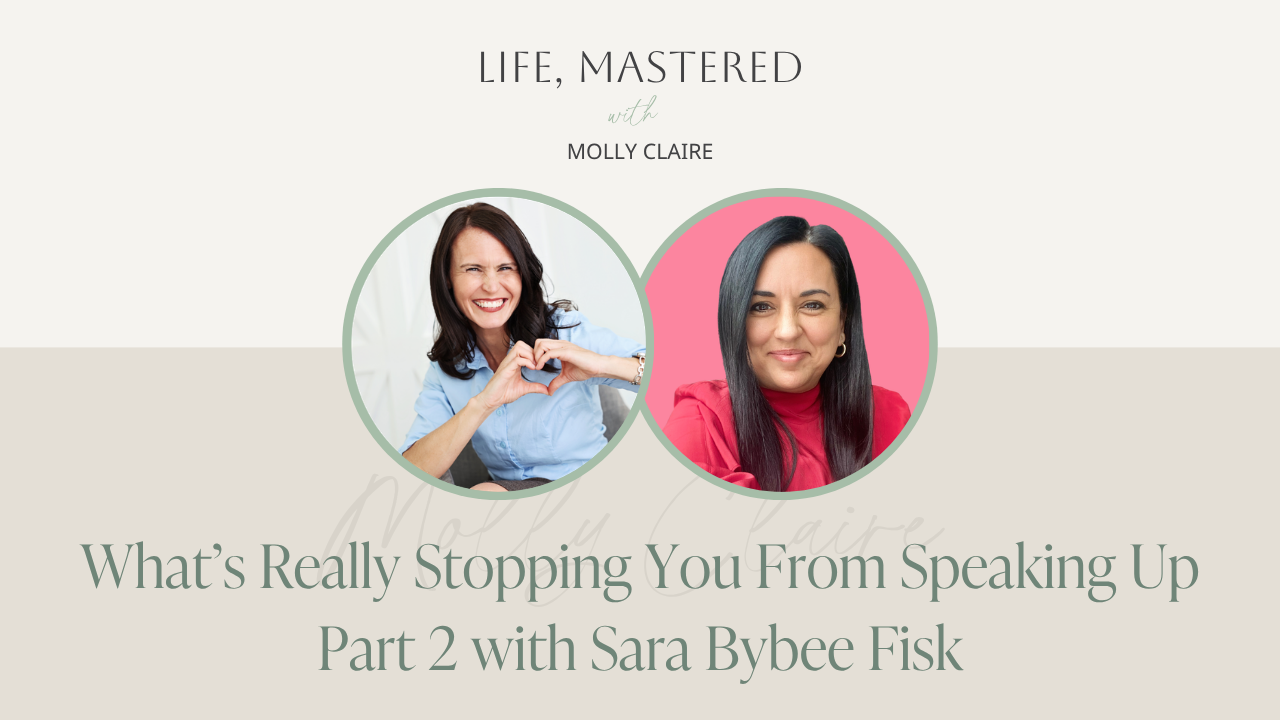
Follow the show:
Apple Podcasts | YouTube Music | Spotify | iHeart Radio | Amazon Music | RSS
What if you didn’t have to know exactly how a hard conversation would go before you were willing to have it? If you knew that you could speak up and handle whatever happened next, how much more freedom would you have in your relationships?
This episode is the second part of my conversation with Master Coach Sara Bybee Fisk, where we’re talking about one of the most important skills for women: learning how to have hard conversations. When you’re able to stop rehearsing, trying to find the right words, and walking on eggshells until it’s the “right time” to speak up, you get your life back and gain the confidence to have any conversation you need to. Last week, we laid the groundwork for understanding why so many women struggle with this skill. This week, we’re diving into actually developing the tools that help you speak up in your life.
Sara shares three foundational skills she teaches women to help them have these conversations: stop debating whether something matters, say what you actually mean without editing yourself to manage someone else’s reaction, and trust yourself to handle whatever happens afterward. We also explore how to recognize when fear is keeping you from speaking up, and what effective communication actually looks like.
Speaking up helps you know yourself more deeply and build more honest connections in your relationships. When you trust yourself to have the conversation and handle whatever comes next, you get to decide which relationships you want to invest in and how you want to show up in them. That’s the kind of freedom and confidence I want for all of you listening. Let’s dive in!
What you’ll learn:
- The three skills that will help you have hard conversations with more confidence
- How to stop debating whether something is “valid enough” to bring up and trust that it’s enough if it matters to you
- How to recognize when fear of someone’s response is keeping you from speaking up
- Why trusting yourself to handle whatever happens after you speak up is an important part of the process
- How parts work can help you care for the part of you that feels afraid to have a hard conversation
Listen to the episode:
About Sara Bybee Fisk
Sara Bybee Fisk coaches capable women through the conversations they're afraid to have. As a Master Certified Coach and host of the Ex-Good Girl Podcast, she's worked with thousands of women in medicine, business, and faith communities who've done years of personal work but still freeze when something they care about is at stake. Her approach is straightforward: most women don't need another insight or a better script. They need to interrupt the calculation loop that runs before they ever open their mouth, what she calls “Good Girl Math”. Sara teaches three concrete skills to help women locate exactly where they get stuck and what needs to change. She's a born-again feminist who grew up in a high-demand religion and now speaks nationally on conflict, communication, and what it looks like when women finally learn the skills needed to have any hard conversation they need to have.
Website: sarafisk.coach
Podcast: sarafisk.coach/podcast
Instagram: instagram.com/sarafiskcoach
Free workshop: sarafisk.coach/voice
Connect with Molly Claire
Book your 90-day business strategy VIP day
Master Coach Training 2026 Application Open
Get the book: She Rises: Insights and Wisdom from the Women of The Masterful Coach Collective
Molly’s Website: MollyClaire.Com
Have a question or thoughts about the podcast? Don’t hesitate to contact Molly at:
Molly’s book: The Happy Mom Mindset: mollyclaire.com/book
Free resources:
Please help Molly reach even more like-minded individuals! Simply post a review of the podcast on your favorite platform (or two). It is so appreciated.
Are you a leader, coach, or business owner who wants to inspire, influence, and cultivate lasting change in yourself or others? Unlock your full potential as a leader and coach with the 4 fundamentals of lasting change coach training program.
Apple Podcasts | YouTube Music | Spotify | iHeart Radio | Amazon Music | RSS
Full Episode Transcript:
Molly Claire 00:39
Hello, hello. Welcome to today's podcast episode. This is part two of the conversation that I had with Sara Bybee Fisk, where she is continuing to talk about how to speak up. How do we face and have those hard conversations? And last week, we learned about this in the beginning of the conversation. Today, she is sharing with you the three foundational skills that you have to have in order to make speaking up be something that is easier for you and something that you do more regularly. And the reality is that every time we don't speak up and we close off our emotions, we are limiting ourselves. We are limiting ourselves from greater expansion. We are limiting the connection in our relationships. We are really limiting ourselves from speaking up about what matters to us, how we feel, and, and the things that we have conviction about. So such an important episode. I know you are going to love it. Before we dive into that, I wanna let you know about an exciting new way that I am working with my clients. I am now offering VIP days with my clients, and there are a couple of ways that you can do these. One is a VIP day to create your coaching program start to finish that day. So I use my core curriculum, the program that I've done for years, Create Your Killer Program, and with that, we're gonna personalize it. We're gonna have you all ready for the day to get started. And by the end, other than if there are a lot of materials that you need to create, of course, those will be created afterward, but everything will be organized, start to finish, client journey, everything you're gonna teach, worksheets, and it is just a power-packed day. So I'm so thrilled to bring this opportunity into a one-day experience because let's face it, we can put things off forever. Let's dive in and get it done. The other VIP day option that I offer up to you and anyone who's been interested in having an organic marketing plan that does not require you to learn the algorithm of the paid ads and all the things and all the platforms, I offer a VIP strategy day where we're putting together your 90-day organic growth strategy. This is perfect for you if you are a coach who loves coaching and wish that you didn't have to deal with marketing and sales so much. I get you. I understand you. We're gonna take that day. We're gonna get you moving forward and have a plan that feels perfectly aligned for your gifts and for the type of business that you desire to have and the one that supports your ideal life. So you can check these offers out in the show notes, or you can head over to mollyclaire.com.Click on the Work With Me tab, and I am booking VIP days starting in October. So all right. Let's go ahead and get started with the amazing Sara Bybee Fisk.
Sara Bybee Fisk 03:44
I have coached thousands of women now through, you know, eight years of these hard conversations, and it really comes down to three foundational skills. The first one, you gotta stop debating it.
Molly Claire 03:57
Mm-hmm.
Sara Bybee Fisk 03:58
And this skill is about the ability to decide that just because this matters to me, that's enough. That's enough of a reason to bring it up.
Molly Claire 04:08
Mm-hmm.
Sara Bybee Fisk 04:09
I don't need proof. I don't need permission. I don't need outside validation first.
Molly Claire 04:16
Mm-hmm. Mm-hmm. And I think of that in the lens of, you know, when I, when I teach my coaches about how, how they support their clients in creating change, one of the first things-- I mean, it's the beginning, the middle, and the end of all of it. It's, it's knowing the self, right? Validation of the self, and really believing that we matter, and that's it, right? Like, it, it has to be enough. If I have a need, if I need to speak up about something, if something matters to me, that's enough.
Sara Bybee Fisk 04:53
That's it.
Molly Claire 04:53
That's enough.
Sara Bybee Fisk 04:54
That's right.
Molly Claire 04:54
That's enough.
Sara Bybee Fisk 04:55
That's right. And you don't need any more evidence. You don't need anybody else to tell you, "Actually, yeah, that is a problem. You should bring it up." You don't need to build what I often call that internal courtroom case that has all the evidence that you are gonna present if there's any pushback.
Molly Claire 05:13
Yeah.
Sara Bybee Fisk 05:13
Someone could say, "You know, Molly, I disagree with you." And you could just say, "Okay."
Molly Claire 05:19
Yeah. Yeah.
Sara Bybee Fisk 05:20
Or, "I don't think you have the right to bring that up." And you could say, "Okay. Yeah. I understand why you might think that but I disagree, and so it's something that I wanna bring up."
Molly Claire 05:29
Yeah.
Sara Bybee Fisk 05:29
It really is about the skill to just realize just because this bothers me, that is enough.
Molly Claire 05:36
Yeah. Yeah.
Sara Bybee Fisk 05:37
And so I have a couple questions for people listening to kind of answer internally to see if, like, this is a skill that could use some strengthening for them. So number one, how many times does that thing that bothers you have to happen before it counts?
Molly Claire 05:55
Great question.
Sara Bybee Fisk 05:58
How many times do you have to check with someone else, or do you have to check with someone else to see whether what you wanna talk about is reasonable? Are you waiting for it to happen just one more time to really confirm that it is actually a problem?
Molly Claire 06:16
Mm-hmm.
Sara Bybee Fisk 06:17
Last one, if no one else agreed that this was a problem, would it still matter enough to you to bring it up?
Molly Claire 06:26
Hmm. That's a great question.
Sara Bybee Fisk 06:28
And so if you are answering and noticing, like, yeah, actually, I am just kind of waiting one more time. Did I really see what I saw? Does it really matter as much? Am I being unreasonable? And you're just kind of waiting for a little more evidence, then yeah, it might be that skill number one, stop debating it, just learning to bring it up 'cause it matters to you, is something that needs some more work for you.
Molly Claire 06:51
Mm-hmm. Mm-hmm. Yeah. And that's okay, by the way, everyone.
Sara Bybee Fisk 06:55
Yeah, totally.
Molly Claire 06:55
If it needs a little more work, it's okay. We can keep working on supporting ourselves and sorting through this stuff, right?
Sara Bybee Fisk 07:02
Yeah. And I would go one step further and say it makes so much sense that because how many times did you bring something up when you were little and somebody said, "Are you sure? Is that really what happened? Are, are you sure you're not being too sensitive about this?"
Molly Claire 07:16
Mm-hmm.
Sara Bybee Fisk 07:16
"You're being a little dramatic about this."
Molly Claire 07:18
Mm-hmm.
Sara Bybee Fisk 07:18
And so all of that early messaging really lays the foundation for self-doubt.
Molly Claire 07:24
Yeah. Yeah, absolutely. And then we have those patterns, right? A pattern of how we engage.
Sara Bybee Fisk 07:29
That's right.
Molly Claire 07:29
Anytime something comes up we don't like, immediately our internal world pushes it against it or tries to say, "Oh, it doesn't matter."
Sara Bybee Fisk 07:37
That's right.
Molly Claire 07:37
Yeah.
Sara Bybee Fisk 07:38
That's right. I have a lot of clients who say things like, "Well, I'm like, I'm like hinting at things. I'm dipping my toe in-" like bringing this thing up. And that's what we do. We bring it up sideways, we hint at it, we, we make it seem smaller than it really is.
Molly Claire 07:55
Mm-hmm.
Sara Bybee Fisk 07:55
And that's what we do when we don't really believe. Like, listen, just because this matters to me, that's enough.
Molly Claire 08:01
Mm-hmm.
Sara Bybee Fisk 08:01
That's enough of a reason.
Molly Claire 08:02
Mm-hmm. Mm-hmm. Yeah. Yeah.
Sara Bybee Fisk 08:04
And that kind of actually takes us to skill number two, which is say what you actually mean.
Molly Claire 08:11
Mm-hmm. Mm-hmm.
Sara Bybee Fisk 08:12
This skill is about the ability in conversation, once it has begun, to stick to what you actually want to say without editing yourself or your message to manage someone else's reaction.
Molly Claire 08:29
Mm-hmm.
Sara Bybee Fisk 08:31
So we might notice that if we don't really have this skill solidly down, uh, or under our belt, we start to soften or over-explain or we leave things out of the thing that we want.
Molly Claire 08:49
Mm-hmm.
Sara Bybee Fisk 08:49
That's how we edit and soften our message.
Molly Claire 08:52
Mm-hmm.
Sara Bybee Fisk 08:52
Or we start to make ourselves smaller, nicer, less certain.
Molly Claire 08:57
Mm-hmm. Mm-hmm.
Sara Bybee Fisk 08:57
I could be wrong, maybe I'm wrong about this, easier to agree with.
Molly Claire 09:02
Mm-hmm.
Sara Bybee Fisk 09:03
And you might change what you say or how you are because you're hoping it makes your message easier to hear and they're not gonna get mad at you.
Molly Claire 09:13
Mm-hmm. So tell me with this one, how do you speak to, um... Because I think anyway that there is, there are communication skills where we can have the skills to speak to people in a way where things will be more easily received or understood, right? And we hear a lot about the language of, you know, you, like accusatory language versus I statements and stuff. So I would love to know your approach or philosophy around that, right? The difference between editing or holding back or trying to manage the other person's feelings about something, uh, that versus having, um, effective communication skills, right? Saying the words that are l- more likely to cultivate openness and less likely to, you know, create like a, a, uh, shutdown response.
Sara Bybee Fisk 10:13
That's a great question, and I'm so glad you brought it up because this skill is not about being loud, bossy, bitchy, mean, and like, "I'm here to say this thing that I need to say. I don't care how you feel, I don't care how you respond. I just need to say it." Certainly, could there be some conversations like that? Sure. But most of the time, I would say 90% of the time, we are trying to have a conversation in a relationship that we want to protect.
Molly Claire 10:42
Yeah. Right. Of course.
Sara Bybee Fisk 10:44
And so what I will say is that this is the top line skill, meaning, you know, say what you actually mean.
Molly Claire 10:49
Mm-hmm.
Sara Bybee Fisk 10:49
But there's 50 micro skills underneath that, that support this.
Molly Claire 10:56
Yeah.
Sara Bybee Fisk 10:56
And one of those skills is openness to the other person's information and experience.
Molly Claire 11:04
Mm-hmm. Mm-hmm.
Sara Bybee Fisk 11:05
So when I'm teaching this skill, I teach how to ask good questions.
Molly Claire 11:10
Mm-hmm. Mm-hmm.
Sara Bybee Fisk 11:11
So let's go back for just a second to, you know, um, the example I started with where I wanna tell one of my friends something that has hurt me, and let's say you're my friend. And so I know that it matters enough to bring it up, and I want to actually say, "You know, Molly, when that thing happened, it, it hurt." But then I also wanna say, "Can you tell me what was going on for you during that interaction?"
Molly Claire 11:32
Mm-hmm.
Sara Bybee Fisk 11:32
"Because what it, what it felt like on my side was, you know, I tried to set up a coffee date with you. You changed it several times, and then you didn't really tell me why. And so it just made me feel like maybe you didn't want to have coffee with me, but I know that's my feeling, and I'm wondering what was going on for you."
Molly Claire 11:52
Mm-hmm. Mm-hmm.
Sara Bybee Fisk 11:52
And so it's not just about, like, I did say what I wanted to say.
Molly Claire 11:57
Yeah.
Sara Bybee Fisk 11:57
This happened, and I felt this way. But then there's also other ways to be open to the other person because it is a relationship that I'm trying to protect.
Molly Claire 12:07
Yeah. Yeah. And I think those skills are so important because I think sometimes, I don't know if you've experienced this, but I think sometimes people can uh, I don't know, swing to the other side of the, like, go to the other side of the spectrum is really the right way of saying it, but kind of like, you know, going from trying to manage the other person's feelings to thinking, "Well, I'm not responsible for anyone else's feelings, so I just..." and then to kind of be like a, almost like a wrecking ball with communication which is not very helpful, right? We wanna be, we wanna be relational. We wanna have the skills to communicate well, and so yeah, there, there can be a learning curve there with all those little micro skills.
Sara Bybee Fisk 12:51
Yeah.
Molly Claire 12:52
Yeah.
Sara Bybee Fisk 12:52
And while that swing is not helpful, it is very normal.
Molly Claire 12:56
Yeah, yeah.
Sara Bybee Fisk 12:56
So if you find that happening, especially a lot of women that I work with, they just get to a point where they are just sick of it.
Molly Claire 13:04
Yeah.
Sara Bybee Fisk 13:04
They're done with it. They are so resentful and so angry and so fatigued about, you know, all the things that they've been doing that they do swing all the way over, and that's good information to have, 'cause you and I both know, like, our emotions are information.
Molly Claire 13:20
Mm-hmm, mm-hmm.
Sara Bybee Fisk 13:20
And anger in particular, resentment in particular, means there's part of us that we're not taking good care of.
Molly Claire 13:26
Mm-hmm.
Sara Bybee Fisk 13:26
And so it's good to notice that, but again, humans are relational. We need each other.
Molly Claire 13:32
Mm-hmm.
Sara Bybee Fisk 13:32
Only time it is absolutely true that you are not in charge of another person's emotions or you are not in relationship with other person's emotions is when it's somebody that you don't care about.
Molly Claire 13:44
Yeah.
Sara Bybee Fisk 13:44
And you don't care if you have any kind of relationship with them.
Molly Claire 13:47
Yeah, yeah.
Sara Bybee Fisk 13:47
But when you do have a relationship you wanna protect, it is part of getting this skill well-developed.
Molly Claire 13:54
Yeah.
Sara Bybee Fisk 13:54
That you can take care of yourself and be open to the other person as well.
Molly Claire 13:59
Yeah, yeah. I saw this... I wish I could remember where this, this came from, but I saw this quote the other day that said something along the lines of, you know, you're not responsible for your partner's feelings, but you are responsible for caring for their heart, or something like that, which I thought was a really beautiful way of saying, yeah, like, I'm not in charge of their feelings. I can't control their feelings. But yeah, I'm here to care for them, right, and be in relationship with them, and, and be... Anyway, so I thought it was kind of a good way of thinking about it.
Sara Bybee Fisk 14:36
Yes.
Molly Claire 14:36
Yeah, yeah.
Sara Bybee Fisk 14:37
In the healthiest relationships, we do take care of each other.
Molly Claire 14:40
Of course.
Sara Bybee Fisk 14:41
We do help each other regulate. We do sacrifice and do things, but it's reciprocal, and it is done, you know, with consent and with, and, and with both people being willing to do that. And that is a kind of intimacy and vulnerability that is really beautiful to have with another person.
Molly Claire 14:59
Yeah, I think it's, it, there's, there's a healthy way, right, a healthy way of engaging and supporting one another back and forth. Yeah. Yeah.
Sara Bybee Fisk 15:08
So a couple of the things that might be happening if this skill needs some work, say what you actually mean, is you might notice yourself always looking for a, quote-unquote, better way to say it.
Molly Claire 15:21
Mm-hmm. I've been there at times in my life.
Sara Bybee Fisk 15:26
Yeah, yeah. And that's not to say that there aren't some words that would be more effective than others, but if you notice you're constantly in that loop, if you notice that you are spending an inordinate amount of time trying to figure out what would be easiest for them to hear instead of figuring out what you actually want to say that might be an indication that this skill needs some work. And then the last one is do you notice when you're in conversation that you soften, that you backtrack, that you try to explain, that you leave things out or try to make it sound less important?
Molly Claire 16:02
Mm-hmm.
Sara Bybee Fisk 16:02
Then that's an indication that this skill needs some work.
Molly Claire 16:06
Mm-hmm, mm-hmm. Yeah, and I think, I know this is a bit of an offshoot or a tangent from this, but I, I, it's certainly coming to my mind. I'm thinking about a relationship in particular that I was in that was really unhealthy, really pretty detrimental, and as you were talking about those things, it was like that was happening for me more and more, and I think it was very indicative of the relationship and the communication being so unsafe and detrimental, too. So just something I think to be aware of sometimes when those dynamics are happening.
Sara Bybee Fisk 16:45
Well, and this is why you need a coach.
Molly Claire 16:48
Yeah.
Sara Bybee Fisk 16:48
Because when you come to a session and there's, you know, you've wanted to have this talk with, um, you know... Let me give you an example. One of the women that I work with owns a family-owned business, and she wanted to pass it off to her daughter, and the daughter just was not stepping into the leadership role that had been outlined for her. And so in the beginning, my client was like, "No, I just need to talk to her. I just need to talk to her. I just need to talk to her." And then four weeks later, when the conversation still hasn't happened, I'm like, "You know what? Instead of talking about the conversation, let's talk about why you're not having it." And the daughter had an explosive anger issue and it just didn't feel safe. And so I'm like, "Okay now we need to talk about, now we need to talk about this."
Molly Claire 17:32
Yeah, yeah.
Sara Bybee Fisk 17:33
So that's why coaching is so essential, because you can't see from the outside-
Molly Claire 17:38
You really can't
Sara Bybee Fisk 17:39
... which of these skills need help, let alone how to develop them sometimes. And so having someone outside of you to help you see that is, is what actually moves the needle forward.
Molly Claire 17:49
Yeah, yeah, yeah. Okay.
Sara Bybee Fisk 17:51
So skill number three is handling whatever happens after. And this skill is about being able to trust yourself that whatever happens after this conversation, I will just deal with it, rather than trying to prevent and predict all of the possible outcomes.
Molly Claire 18:12
Mm-hmm, mm-hmm. And I would imagine adding to that building that resilience, that confidence, and that capability to be able to be there for ourselves and our emotions in the aftermath of it.
Sara Bybee Fisk 18:28
That is, that is one of the most important skills because what it speaks to, what you just said is, I can feel any feeling that I need to feel. If I have a conversation and it goes poorly, and I'm a little embarrassed or maybe ashamed, and I feel guilty, I can be with myself in those really uncomfortable emotions, process them, learn from them, and then just try again.
Molly Claire 18:51
Yeah, yeah. Whereas oftentimes, right, the feelings after are too hard to handle, or we begin to think, "I should have never said that. This is my fault."
Sara Bybee Fisk 18:59
That's right.
Molly Claire 19:00
"I have too many needs," right?
Sara Bybee Fisk 19:02
That's exactly what happens. And so if this skill isn't super solid for you, you might notice that you become very scared of their reaction, their disappointment, their defensiveness, their anger, and it starts to make you do this what you just said, questio whether you should've said anything.
Molly Claire 19:25
Mm-hmm. Mm-hmm.
Sara Bybee Fisk 19:27
You might notice that you're trying to predict how it will turn out before you're even willing to start the conversation.
Molly Claire 19:36
Yeah. Yeah, yeah.
Sara Bybee Fisk 19:36
You're watching for the right mood. You're watching for the right time. And then the last one to think about is if they have a reaction that isn't what you hoped for, it changes your mind about whether or not you should have brought it up in the first place and you blame yourself.
Molly Claire 19:55
Yeah, yeah. Exactly. Exactly.
Sara Bybee Fisk 19:58
So here's where knowing about parts really matters. And so for just a kind of a basic definition, a part is just like a little subpersonality that has worries and concerns, and is trying to get something that it think really matters for your life to work the way it should work.
Molly Claire 20:21
Mm-hmm.
Sara Bybee Fisk 20:21
If you've ever seen the movie Inside Out, it's kind of my favorite, you know, cartoon depiction. A lot of times parts have emotions like those, like that, um, show depicts, but sometimes they just are trying to help you with something. And so throughout each of these steps, there is a part that is scared.
Molly Claire 20:42
Mm-hmm.
Sara Bybee Fisk 20:43
And taking care of that scared part is really essential. That scared part wants your relationships to feel good and safe, wants you to have friends, wants you to have a job, wants you to be able to, you know, get the things that you want within the boundaries of what it learned was okay when you were little, because that's when a lot of these parts are programmed with the beliefs that they carry.
Molly Claire 21:11
Mm-hmm. Mm-hmm.
Sara Bybee Fisk 21:13
So when I wanted to tell my husband that I wanted to be closer, there was a part of me that was like, "Don't do it. Don't do it. He's not gonna like it. He's gonna think you're needy. He's gonna think you're asking for too much. You're fine. This is a good relationship. Just be satisfied with what you have. Why do you want more? Why do you always have to want more?"
Molly Claire 21:32
Mm-hmm.
Sara Bybee Fisk 21:33
That part is just trying to stop me from losing what I have because when I was little, I did experience the loss of connection by asking for things.
Molly Claire 21:46
Mm-hmm. Mm-hmm.
Sara Bybee Fisk 21:47
And so the part of us that is scared will show up at each of these different points.
Molly Claire 21:54
Mm-hmm.
Sara Bybee Fisk 21:54
And what it needs is what you talked about in the beginning. It needs to not know that it's alone. It's th- to know that it's not alone with that fear.
Molly Claire 22:05
Yes. Yeah.
Sara Bybee Fisk 22:06
It needs the companionship of who we are today, the adult who has resources, who has skills.
Molly Claire 22:15
Yeah.
Sara Bybee Fisk 22:15
I imagine it just like taking the hand of a younger version of me. I keep pictures of me when I was eight and seven and, you know, I keep 'em here.
Molly Claire 22:28
Mm-hmm.
Sara Bybee Fisk 22:29
Because I need to remind myself that when I'm afraid to speak up, it's not me, the 53-year-old adult woman.
Molly Claire 22:36
Mm-hmm.
Sara Bybee Fisk 22:37
It's the eight-year-old. It's the five-year-old. It's the seven-year-old who learned sometimes speaking up is really painful.
Molly Claire 22:44
Mm-hmm.
Sara Bybee Fisk 22:45
But what I can offer her today is my companionship and my assurance that we're gonna work through it together. If there's a negative feeling or something feels bad, we're just gonna feel it together.
Molly Claire 22:59
Mm-hmm.
Sara Bybee Fisk 23:00
That I really appreciate her trying to help but that it's okay. We have a plan. If something bad happens, we'll just have another conversation about it. We'll feel anything we need to feel, and to reassure that little scared part that we can handle this.
Molly Claire 23:17
Mm-hmm.
Sara Bybee Fisk 23:17
We can handle it together.
Molly Claire 23:19
Mm-hmm. Yeah. Yes. Yes. I'm just... You know, in my mind, I'm just thinking about how powerful it is, right, when we, when we comfort a child or comfort a friend, right? And we really do have the ability to do that for ourselves, for that part of ourselves. Yeah.
Sara Bybee Fisk 23:39
We do.
Molly Claire 23:40
Yeah.
Sara Bybee Fisk 23:40
And sometimes it's easier, and I'll just say to people listening, sometimes it's really easy to imagine yourself as a small child. That feels, like that fills you with so much compassion. You're like, "Of course. Come here. Let me give you a hug. Sit with me. Let me put my arm around you. This is gonna be okay." And for other people, that doesn't feel good, and so what feels better is to just imagine a different child that they love.
Molly Claire 24:03
Mm-hmm. Mm-hmm.
Sara Bybee Fisk 24:04
And what that child would need if it came to you and said, "I'm really scared to tell, you know, my dad that I want him to come to my birthday. What if he says he doesn't want to?"
Molly Claire 24:13
Mm-hmm.
Sara Bybee Fisk 24:14
And so to offer that other child the same type of love and reassurance, and you can do that internally. I like to just take a few minutes, put my hand on my chest and say, "Yeah, I understand why you're... This makes so much sense that you're scared to bring this up. Yeah I would be, too, but I'm here with you and we're gonna get through this together."
Molly Claire 24:35
Yeah, and I think I love that you brought that up, because I think sometimes it can feel, some of these strategies can feel out of reach sometimes. I know for me, sometimes even it's going for a walk and talking to myself, or even journaling, right? Writing to myself or about what I'm feeling with that. So there are just so many ways we can do it, so.
Sara Bybee Fisk 24:56
Absolutely. So having each of those skills, you don't even have to have them perfectly. And again, I'll say that under each of those, there's a bunch of sub-skills that support that top-line skill. But when you have those skills, two things happen. Number one, you know I can always just have another conversation about it.
Molly Claire 25:19
Mm-hmm. Mm-hmm.
Sara Bybee Fisk 25:20
And I'll just bring it up again. Or now that I know that this is not something that we're gonna talk about successfully, I can make different decisions about my time and my energy and what I do. Because one of the things that we're afraid of is things going badly, and it changing the relationship. But I just wanna remind everyone, you always have the final say about what to do with your side of that relationship.
Molly Claire 25:47
Mm-hmm. You know, as you're talking, just what's coming to my mind is that the more we can be honest, the more we can speak what's true, speak what we need, I think we'll have more honesty in our relationships, and it will become more clear to us the relationships that we actually want in our life.
Sara Bybee Fisk 26:08
That is right. That is right.
Molly Claire 26:09
Yeah.
Sara Bybee Fisk 26:09
And that's the second thing that happens. When you have this skill, the relationships that respond to this, the relationships that are like, "Thank you so much for bringing this up. I would never want you to think that I was changing our coffee date because I didn't wanna spend time with you," then you know each other better. You see each other more clearly, and now you have an increased level of intimacy and connection, and that's what we long for.
Molly Claire 26:39
Yeah. Yeah.
Sara Bybee Fisk 26:40
To be truly seen and truly known is the greatest gift that relationships offer us. And when my husband and I, you know, have gone through a lot of these conversations, and in the beginning I was really afraid to tell him that I wanted to be closer to him. It kind of felt like we were, you know, I have five kids. They, we had them all kind of close together. There was a lot going on, and we just became like roommates after a certain period of time. And it was fine. The relationship was good. There wasn't anything really, you know, bad going on. But I remember how scared I felt to tell him, like, "I actually wanna be closer to you."
Molly Claire 27:20
Mm-hmm.
Sara Bybee Fisk 27:21
And the fear that I felt, like what if he said, "I don't want that," or, "No, I, I think things are fine." And when he said, "Oh my gosh, I've wanted that, too, and I just haven't known how to tell you," now you have the option for exactly the kind of relationships that make life worth living.
Molly Claire 27:37
Mm-hmm. Mm-hmm. I love that, and I think, you know, it just reminds me that I always think that it's such a beautiful thing when we realize that having needs is such a beautiful thing.
Sara Bybee Fisk 27:55
Yeah.
Molly Claire 27:55
Because a lot of times, right, the needs that I have, the things that I want that maybe I fear are gonna be a burden to someone else, that other person in my life is thrilled to be able to fill that need, is thrilled to be able to lean in and be there for me, and vice versa.
Sara Bybee Fisk 28:14
That's right.
Molly Claire 28:15
Right? And so-
Sara Bybee Fisk 28:16
That's right. Mm-hmm
Molly Claire 28:16
I love this conversation so much for so many reasons. And I hope as you've all been listening to this, that you're noticing when and where this comes up for you. And I hope that you are giving yourself permission to take a little bit of time to take stock in where you may wanna speak up more, and which of these steps you may want to work on. And you know, I'll just say that, that for me, learning to continue to speak up in different situations and circumstances when I feel challenged once again to speak up, um, continuing that practice is one of the greatest opportunities that I have, because I feel like every single time it strengthens my sense of self, and it helps me to know myself better, and it really does help me to have more, uh, deeply connected, powerful relationships. So it's just, it's worth it. It's so worth it.
Sara Bybee Fisk 29:11
100%. The sense of freedom and power that I feel and that my clients feel is really amazing.
Molly Claire 29:19
Well, Sara, any final words that you have for my listeners? Um, and also, where can they find more about you?
Sara Bybee Fisk 29:27
Final words, this is the skill I want women to have. Whether they choose to use it, you know, in their home, in their community, at work, in, or, you know, in, in, in bigger jobs and roles, that is completely up to them. But we've touched on it. The freedom, the confidence, and the ability, that it just feels so good. And so if you are curious about this, I teach a free workshop where I dive into each of these steps with more depth every single week. You can find it at sarafisk.coach. That is actually a website URL. Backslash voice. Sarafisk.coach/voice. And every week it's live. I answer questions and I do some coaching. I also have a podcast. It's called the Ex-Good Girl podcast. I release weekly episodes that support people working through this, and I would love to see anyone who's listening to this in a workshop or listening to one of the podcast episodes.
Molly Claire 30:25
Amazing. Amazing. And we will link both of those in the show notes here as well. So thank you so much, Sara. It was so great to have you here.
Sara Bybee Fisk 30:35
I appreciate it. And Molly, it's just, it's such... You are such a good conversation partner about these things. And, um, that you can offer that to your clients is just such a richly rewarding experience for them. So thank you for having this conversation with me.
Molly Claire 30:50
Thank you. As we know, these things usually come with a lot of experiences, right, of struggling to do these things for ourselves. So thank goodness we can help others with what we've learned. So all right. Thank you so much. And I will talk with you all next week. Have a good one.